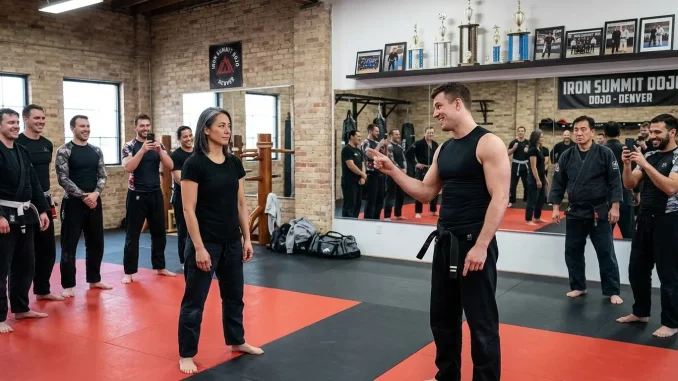
The Dojo’s Best Fighter Challenged a Quiet Woman to a Friendly Match—Then One Move Changed Everything
Posted on October 28, 2026 | By Admin
The laughter inside Iron Summit Dojo stopped the moment Victor Kane hit the mat.
Just seconds earlier, the room had been filled with amused whispers, confident grins, and the casual chatter of students who believed they were about to witness an easy victory.
Victor certainly believed it.
At twenty-nine, he was the most celebrated fighter in the dojo. He had won local tournaments, dominated sparring sessions, and developed a reputation for making difficult opponents look ordinary. His confidence was so deeply rooted that he rarely considered the possibility of losing, especially to someone he had already decided was beneath his level.
And now he was facing a woman who appeared to have no interest in impressing anyone.
Her name was Evelyn Cross.
She was forty-one, wore a plain gray hoodie, and carried a small gym bag that looked as though it had accompanied her through years of training. Silver streaks ran through her dark hair, and her expression remained calm despite the attention gathering around her.
She had not entered the dojo looking for a challenge.
She had simply come to observe a class.
Unfortunately for Victor, he mistook her quiet manner for weakness.
“Come on,” he said, gesturing toward the mat. “Let’s make this interesting.”
A few students laughed.
Evelyn glanced around the room before looking back at him.
“Interesting for whom?”
Victor grinned.
“For everyone watching.”
That answer earned another round of laughter.
What Victor didn’t understand was that the most experienced person in a martial arts room is not always the loudest, the strongest-looking, or the one wearing the most impressive belt.
Sometimes, experience reveals itself through restraint.
And sometimes, the person who appears least interested in proving anything has the most to teach.
The Fighter Everyone Admired
Iron Summit Dojo had built its reputation on discipline, competition, and hard training.
Its students practiced throws, grappling, striking drills, and controlled sparring under the supervision of instructors who emphasized technique as much as physical conditioning.
Victor Kane was the dojo’s biggest success story.
He had arrived several years earlier as a talented but impatient young fighter. Over time, his strength, speed, and competitive instincts had helped him become one of the most successful competitors in the local circuit.
He enjoyed winning, but he also enjoyed being watched while he won.
Whenever new students arrived, Victor usually found a reason to demonstrate his abilities. He would volunteer for difficult drills, offer advice nobody had requested, or challenge another experienced student to a round that somehow became a small performance.
Most people tolerated the behavior because he was genuinely skilled.
He could move quickly, maintain pressure, and capitalize on an opponent’s mistakes. His tournament results were impressive, and his physical conditioning was among the best in the room.
But there was a difference between being a capable fighter and being a mature martial artist.
Victor had not yet learned that distinction.
He treated confidence as proof of superiority. He believed that hesitation meant weakness and that a fighter who did not advertise their abilities probably had very few.
When Evelyn appeared near the wall, wearing ordinary training clothes and carrying no obvious indication of rank, he saw an opportunity.
“Are you here for the beginner class?” he asked.
Evelyn looked toward the instructor.
“No.”
“Then you’ve come to watch?”
“Something like that.”
Victor glanced at the other students.
“Well, you’re welcome to join us. We can always use another volunteer.”
His tone was friendly enough on the surface, but his smile suggested that he expected everyone to understand the joke.
Evelyn didn’t respond.
That silence encouraged him.
“What’s your name?” he asked.
“Evelyn.”
“Victor.”
“I heard.”
A few students chuckled.
Victor’s smile tightened slightly.
He wasn’t accustomed to people ignoring the opportunity to impress him.
“So, Evelyn, do you train somewhere?”
“Sometimes.”
“What does that mean?”
“It means sometimes.”
The students laughed again, this time because they weren’t sure whether she was joking.
Victor folded his arms.
“All right. Let’s see what you’ve got.”
Evelyn looked at him for several seconds.
Then she asked a question that would later become the most memorable moment of the evening.
“Are you asking because you want to learn something, or because you want an audience?”
The room became noticeably quieter.
Victor’s expression changed.
Only briefly, but long enough for anyone paying attention to notice.
“I’m offering you a friendly match,” he said. “Don’t make it complicated.”
“Friendly matches require two people who agree to participate.”
“Do you agree?”
Evelyn glanced toward the dojo’s owner.
Master Daniel Park stood beside the mirrors, watching the exchange with growing concern.
He knew exactly who Evelyn Cross was.
And he knew that Victor had made a serious mistake.
The Instructor Who Recognized Her
Daniel Park had spent more than thirty years studying martial arts.
He had trained in several disciplines, competed when he was younger, and eventually opened Iron Summit Dojo because he wanted students to understand that martial arts were about more than winning.
Technique mattered.
Physical conditioning mattered.
So did humility, patience, and the ability to recognize when a confrontation should be avoided.
Daniel had met hundreds of fighters throughout his career. Some were naturally gifted. Others became exceptional through years of disciplined practice.
A few possessed a rare combination of skill, judgment, and emotional control.
Evelyn belonged to that last group.
He had first encountered her more than twenty years earlier during an intensive training program overseas.
At the time, Daniel was a younger instructor trying to improve his grappling and defensive skills. He had been invited to train at a small facility where experienced practitioners worked without the publicity or ceremony that often surrounded competitive martial arts.
Evelyn had been there.
She was younger then, but her manner was the same. She spoke little, listened carefully, and approached every exercise with a level of concentration that made even experienced students reconsider their assumptions.
Daniel remembered watching her practice with senior practitioners who had spent decades refining their techniques.
She never tried to embarrass anyone.
She never rushed to demonstrate that she was better.
When someone made a mistake, she corrected the movement if asked. When someone became frustrated, she waited patiently. And when a training partner lost balance, she made certain the person could recover safely.
Her ability was obvious, but her restraint had made an even greater impression.
Daniel had not seen her in years.
Yet the moment she stepped into Iron Summit, he recognized her.
Now he watched Victor attempt to turn her into the evening’s entertainment.
Daniel took a step forward.
“Victor,” he began, “perhaps we should—”
Evelyn glanced at him and gave the smallest shake of her head.
It was not an invitation to fight recklessly.
It was a request to let Victor make his own decision.
Daniel stopped.
He didn’t like what was happening, but he understood her intention.
Some lessons could not be delivered through a lecture.
Victor, meanwhile, interpreted the silence as approval.
“Thirty seconds,” he announced. “I’ll go easy.”
Evelyn raised an eyebrow.
“That would be considerate.”
A few students laughed.
Victor turned toward the center of the mat.
He was certain the match would end with him standing over an opponent who had underestimated him.
He had no idea that his own assumptions were about to become his greatest disadvantage.
The Challenge Nobody Took Seriously
Evelyn removed her hoodie, folded it neatly, and placed it beside her gym bag.
Underneath, she wore a plain black training shirt.
There was nothing theatrical about her preparation.
She didn’t bounce on her toes or shake out her arms. She didn’t announce her experience or explain where she had trained.
She simply stepped onto the mat.
Daniel straightened.
He had seen that quiet concentration before.
Victor rolled his shoulders and raised his hands.
“You’re supposed to put your guard up,” he said.
Evelyn looked at him.
“You’re supposed to understand your opponent before deciding what they can do.”
The comment drew a few surprised looks.
Victor’s smile faded.
“Is that advice?”
“It’s an observation.”
“Then here’s one for you. You can’t win a match if you don’t defend yourself.”
Evelyn nodded slightly.
“That’s true.”
“Ready?”
“No need to rush.”
That answer irritated him more than an insult would have.
He wanted a reaction. He wanted her to look nervous, become defensive, or reveal that she was uncomfortable under the attention.
Instead, she seemed perfectly content to let him talk.
The instructor supervising the session stepped closer.
“Controlled sparring only,” he reminded them. “No unnecessary force. If either of you wants to stop, the match stops.”
Evelyn agreed.
Victor gave a confident nod.
They took their positions.
Around them, the students gathered into a loose semicircle. Some were already smiling in anticipation. Others had begun recording on their phones, expecting a short, entertaining demonstration.
Daniel looked at the crowd.
“Put the phones away,” he said.
A few students hesitated.
“Now, please.”
The phones disappeared.
The room settled.
Victor moved lightly on his feet, studying Evelyn’s posture.
She stood comfortably, her hands relaxed, her weight balanced.
He interpreted her lack of obvious preparation as inexperience.
What he failed to recognize was that she was paying attention to everything.
The distance between them.
The position of his feet.
The direction of his shoulders.
The rhythm of his breathing.
The way his confidence influenced his decisions.
Evelyn wasn’t trying to predict every possible movement. She was waiting for him to commit to one.
Victor finally smiled again.
“Let’s make this quick.”
Then he moved.
The Three Seconds That Changed the Room
Victor advanced confidently, reaching toward Evelyn’s upper body in an attempt to establish control.
He expected her to retreat.
Most beginners did.
He expected her to stiffen, pull away, or respond with a movement that would leave her balance exposed.
Instead, Evelyn adjusted her position by a fraction.
She moved just enough to change the distance between them.
Her hand made brief contact with his wrist.
Her body turned.
Her foot shifted into position.
The movement was so compact that several students didn’t understand what had happened until Victor was already losing his balance.
There was no dramatic windup.
No exchange of wild strikes.
No prolonged struggle.
One moment, Victor was advancing.
The next, he was falling.
His back met the mat with a heavy thud that echoed through the room.
Every smile disappeared.
For a second, nobody spoke.
Victor lay on the mat, staring upward, trying to understand how a movement that had looked so ordinary had ended with him on the floor.
Evelyn remained balanced.
She released his wrist immediately and stepped away, giving him room to recover.
She had not continued the movement after the outcome was clear.
She had not celebrated.
She had not raised her arms or looked toward the spectators.
She simply waited.
The entire exchange had taken only a few seconds.
But those seconds had revealed something the previous ten minutes had not.
Victor had been so focused on how he expected the match to unfold that he had failed to recognize the possibility of another outcome.
Evelyn offered him a hand.
“Are you all right?”
He stared at her hand.
For the first time since she had entered the building, he appeared to have no prepared response.
“I’m fine,” he said finally.
He accepted her help and stood.
His face was flushed, but there was no obvious sign of injury.
Evelyn stepped back.
“Good.”
That was all she said.
The silence around them became uncomfortable.
Victor glanced toward the other students, apparently hoping to find some sign that the moment had not been as embarrassing as it felt.
Nobody laughed.
The students who had expected an easy victory were now studying Evelyn with entirely different expressions.
Some looked curious.
Others looked surprised.
One young man near the mirrors quietly shook his head, as if replaying the movement in his mind.
Daniel Park finally exhaled.
He had known how the exchange might end.
Even so, watching it unfold reminded him why experience could not be measured by appearance alone.
The Question Victor Was Afraid to Ask
Victor adjusted his training shirt.
“Do it again,” he said.
Evelyn shook her head.
“Why?”
“Because I wasn’t ready.”
“You asked for the match.”
“I didn’t know what you were going to do.”
“Neither did I, until you moved.”
A few students exchanged glances.
Victor looked irritated.
“That’s not what I mean.”
“Then explain what you mean.”
He opened his mouth, but no answer came immediately.
He wanted to insist that the result had been a fluke. He wanted another opportunity to prove that his reputation was deserved.
But the more he considered the exchange, the more difficult it became to dismiss.
Evelyn had not overwhelmed him with obvious strength.
She had not won through speed alone.
She had waited for an opening and used a simple movement at precisely the moment it became effective.
That realization was more uncomfortable than the fall itself.
“Where did you train?” he asked.
Evelyn glanced toward Daniel.
“Different places.”
“Which ones?”
“Why does it matter?”
“Because I’ve never seen anyone move like that.”
She considered his statement.
“Then perhaps you’ve spent too much time training against people who move the way you expect them to.”
The words were quiet.
They landed harder than an insult.
Victor’s expression changed again.
This time, he didn’t look angry.
He looked uncertain.
Daniel stepped forward before the conversation could become another confrontation.
“Let’s take a breath,” he said. “Everyone, return to your stations.”
The students began moving, though most remained distracted.
Victor stayed near the center of the mat.
Evelyn reached for her hoodie.
“You’re leaving?” he asked.
“I came to observe the class.”
“That’s all?”
“That was the plan.”
Victor looked toward Daniel.
“You knew who she was.”
Daniel didn’t answer immediately.
“Yes,” he said.
“Why didn’t you tell me?”
“Because you didn’t ask who she was. You decided what she was.”
Victor looked down.
The instructor’s words seemed to settle over him more slowly than the fall had.
For the first time that evening, he had to consider the possibility that his greatest mistake had happened before the match even began.
The Story Behind Evelyn Cross
The students gradually returned to their exercises, but the atmosphere had changed.
People spoke more quietly. Several glanced toward Evelyn as she placed her hoodie into her bag.
A young woman who had been practicing near the wall finally approached.
“Excuse me,” she said. “Are you a professional fighter?”
Evelyn smiled faintly.
“Not in the way you’re probably imagining.”
“Then how did you learn to do that?”
“Years of practice. Good instructors. Plenty of mistakes.”
The student waited, expecting more.
Evelyn zipped her bag.
“And learning not to confuse winning with proving something.”
The young woman nodded slowly.
“Do you teach?”
“Occasionally.”
“Would you ever teach here?”
Evelyn glanced at Daniel.
“That’s a question for the owner.”
Daniel smiled.
“We would be fortunate to have her.”
Victor had been listening from several feet away.
He approached more slowly this time.
“Master Park,” he said, “who exactly is she?”
Daniel folded his arms.
“Her name is Evelyn Cross. She has trained in several martial arts disciplines and has spent years working with experienced practitioners. I’ve seen her help students improve without making them feel small. I’ve also seen her stop a confrontation before it became dangerous.”
Victor looked toward Evelyn.
“Is that why you didn’t put your hands up?”
Evelyn shook her head.
“No. I was waiting to see what you would do.”
“That’s it?”
“That’s enough to begin understanding someone. Not enough to understand everything.”
Daniel nodded.
“That is an important distinction.”
Evelyn continued.
“You were fast. You were confident. You knew how to move. None of that was the problem.”
Victor looked at her carefully.
“Then what was?”
“You were trying to win a match before you had even started listening to the person in front of you.”
He glanced away.
She had not called him weak.
She had not questioned his athletic ability.
She had identified a problem he could actually work on.
That made it difficult to argue.
A Different Kind of Lesson
Later that evening, after most of the students had finished training, Victor remained on the mat.
Evelyn was speaking with Daniel near the entrance when he approached them.
“Could I ask you something?” Victor said.
“Of course,” Evelyn replied.
“Would you show me what I did wrong?”
Daniel looked at him with quiet interest.
Victor continued before either of them could answer.
“Not another match. I want to understand the movement.”
Evelyn studied him for a moment.
“Are you asking because you want to learn, or because you want another chance to beat me?”
Victor looked embarrassed.
“Both, probably.”
She smiled.
“At least that’s honest.”
They returned to the center of the mat.
Evelyn explained that the exchange had not depended on a secret technique. It had depended on timing, positioning, and Victor committing to a movement without adequately considering how his opponent might respond.
She kept the explanation general and focused on the principles rather than repeating the throw at full speed.
“Your movement wasn’t necessarily wrong,” she told him. “Your assumption was.”
Victor listened.
“You thought I would react in a particular way. You began planning around that expectation. When I moved differently, you were already committed.”
“So I should wait longer?”
“Not always. Hesitation can be a problem, too. The point isn’t to wait forever. It’s to pay attention to what is actually happening instead of fighting the version of your opponent you’ve invented in your head.”
Daniel watched from the side.
This was the kind of lesson he had hoped Victor would eventually learn.
For years, the young fighter had treated every training session as a test of his status. He measured progress by victories, compliments, and the reactions of the people watching.
Now, for perhaps the first time, he was listening to feedback without trying to turn it into a contest.
Evelyn demonstrated the importance of balance and controlled movement using slow, simple examples.
Victor practiced carefully.
He made mistakes.
She corrected them.
He tried again.
Nobody laughed.
After several attempts, he paused.
“That feels completely different when I slow down.”
“Because you’re noticing things you were rushing past.”
He nodded.
For the first time that evening, his attention seemed to be on the training rather than the audience.
The Apology Nobody Expected
When the final students began collecting their belongings, Victor approached Evelyn again.
“I owe you an apology,” he said.
She waited.
“I made assumptions about you before I knew anything about you. Then I turned it into a joke in front of everyone.”
Evelyn listened without interrupting.
Victor continued.
“I thought being the best fighter here meant I had to prove it whenever someone gave me the opportunity.”
“And what do you think now?”
He considered the question.
“I think I was more concerned about looking strong than becoming better.”
Evelyn nodded.
“That’s a useful thing to recognize.”
He looked toward the mat.
“Do you think I can change that?”
“Of course. But you have to practice it the same way you practice everything else.”
“How?”
“Start by listening when someone corrects you. Stop treating every disagreement as a challenge. And when you don’t know what another person can do, admit that you don’t know.”
Victor gave a small, rueful smile.
“That sounds harder than winning a tournament.”
“It can be.”
Daniel laughed softly.
“That’s why we call it training.”
Victor looked at Evelyn.
“Thank you for not making it worse.”
She seemed puzzled.
“What do you mean?”
“You could have embarrassed me much more than you did.”
Evelyn shook her head.
“I wasn’t there to embarrass you.”
“Even after the way I treated you?”
“Especially then. If I had wanted to humiliate you, there would have been no lesson worth remembering.”
Victor lowered his eyes.
That answer appeared to affect him more than anything else she had said.
He had expected mockery.
He had expected Evelyn to enjoy the reversal of their positions.
Instead, she had given him an opportunity to learn without making his mistake the center of the evening.
That generosity made the experience difficult to dismiss.
What Master Park Had Been Trying to Teach All Along
After Victor left, Daniel walked Evelyn toward the entrance.
“I was worried he would push too far,” he admitted.
“So was I.”
“You could have stopped him before the match began.”
“Yes.”
“Why didn’t you?”
Evelyn considered the question.
“Because you were already trying to stop him. I wanted to see whether he could make the decision himself.”
Daniel nodded.
“Do you think he learned something?”
“I think he encountered a question he couldn’t answer with confidence.”
“And that’s enough?”
“It’s a beginning.”
They stood near the doorway, listening to the quieter sounds of the dojo as the last students finished putting equipment away.
Daniel looked toward the mat.
“I’ve told him for years that being a good martial artist means more than winning.”
“Perhaps he finally heard it.”
“What made the difference?”
Evelyn smiled.
“Sometimes advice sounds different after experience gives it meaning.”
Daniel laughed.
“That’s a very polite way of saying you threw him across the mat.”
“I didn’t throw him across the mat.”
He raised an eyebrow.
“He was on the floor.”
“He lost his balance.”
“With your assistance.”
Evelyn laughed for the first time that evening.
The moment passed, leaving the two longtime practitioners standing together in the doorway.
Neither of them considered Victor’s fall a great victory.
The important part had happened afterward, when he chose to ask a question rather than demand another match.
That decision would determine whether the evening became an embarrassing memory or a turning point in his training.
The Next Evening at Iron Summit
When Victor returned to the dojo the following day, he did something the other students immediately noticed.
He arrived early.
Instead of taking the center of the mat and waiting for someone to watch him, he began helping prepare the training area.
He checked the equipment, straightened the practice mats, and helped a newer student understand the schedule.
Nobody made a speech about his behavior.
Daniel simply greeted him and began the class.
During the session, Victor paired with a student who was less experienced than he was.
In the past, he might have treated the exercise as an opportunity to demonstrate his superiority.
This time, he focused on the instructions.
He adjusted the intensity of his movements, gave his partner time to respond, and accepted corrections from the instructor without arguing.
When the other student made a mistake, Victor explained the movement patiently.
It wasn’t a dramatic transformation.
He still had moments of frustration. He still enjoyed winning. And he still had a competitive personality.
But he was beginning to understand that those qualities did not have to control every decision he made.
Near the end of the session, Daniel gathered the class.
“Yesterday, some of you witnessed a very short match that produced a surprisingly long conversation,” he said.
A few students smiled.
“I want you to remember something. Skill is not measured by how confidently you enter a challenge. It is measured by what you understand when the challenge is over.”
He looked around the room.
“Your opponent is not a prop in your personal story. They are a person who deserves respect. If you forget that, you’re no longer training in the spirit of martial arts.”
The room became quiet.
Victor stood near the back, listening.
Daniel continued.
“Winning can reveal what you already know. Losing can reveal what you still need to learn. But only if you’re willing to pay attention.”
The class bowed and returned to practice.
Victor looked toward the entrance, where Evelyn’s gray hoodie had rested the night before.
She wasn’t there.
But her lesson remained.
The Real Meaning of Strength
Over the following weeks, Victor’s approach to training gradually changed.
He began asking more questions.
He paid closer attention to his partners’ movements and stopped assuming that a quiet opponent was an inexperienced one.
He also became more careful about the way he treated newcomers.
When someone entered the dojo for the first time, he introduced himself rather than testing them.
The change did not make him less competitive.
It made his competitiveness more useful.
He still wanted to improve. He still wanted to perform well in tournaments. But he was learning to separate those goals from the need to impress everyone in the room.
One afternoon, a student asked him about the match with Evelyn.
“Was she really that much better than you?”
Victor paused before answering.
“She understood that match better than I did.”
The student looked surprised.
“That’s all?”
“That’s enough.”
He explained that he had entered the exchange with assumptions about Evelyn’s ability, confidence, and intentions. Those assumptions had influenced the way he moved before he had gathered enough information to make a good decision.
He had been so certain he would win that he had failed to recognize the conditions under which he might lose.
The lesson wasn’t that physical strength was unimportant.
It wasn’t that experience guaranteed victory.
And it wasn’t that a single technique could defeat every opponent.
The lesson was that confidence becomes dangerous when it prevents a person from seeing reality clearly.
In martial arts, that can lead to poor decisions.
Outside the dojo, it can lead to disrespect, missed opportunities, and unnecessary conflict.
Victor had learned that the hard way.
He would remember the sound of his back meeting the mat for a long time.
But he would remember Evelyn’s decision to step away even longer.
She had demonstrated that being capable of winning a confrontation does not mean a person must prolong it.
She had shown that control includes knowing when to stop.
And she had reminded him that a skilled opponent is not someone to underestimate simply because they do not look the way you expect.
The Woman Who Never Needed to Prove Anything
Evelyn Cross returned to Iron Summit several weeks later.
She arrived quietly, wearing another ordinary training outfit and carrying the same small gym bag.
This time, nobody laughed.
Several students greeted her. The young woman who had asked about her training came over to say hello, and Daniel welcomed her with the warmth of an old friend.
Victor approached after finishing his warm-up.
“Good to see you again,” he said.
“You too.”
He hesitated.
“I’ve been working on what we discussed.”
“How’s that going?”
“Slowly.”
“That’s usually how improvement works.”
He smiled.
Then he asked, “Would you be willing to train with me sometime?”
Evelyn considered the request.
“Perhaps. If we’re training to learn rather than to impress anyone.”
“Agreed.”
They arranged a controlled session under Daniel’s supervision.
There was no crowd gathering around the mat. No phones appeared. Nobody announced a challenge or predicted an outcome.
They simply trained.
Victor listened.
Evelyn offered corrections.
Daniel observed.
And when the session ended, Victor bowed with genuine respect.
The moment was ordinary, which was precisely what made it meaningful.
There was no need for another dramatic fall or a room full of astonished witnesses.
The lesson had already done its work.
Evelyn had entered the dojo as a stranger whom one confident fighter assumed he could easily defeat.
She left as a respected practitioner who had helped that fighter recognize the difference between appearing strong and becoming better.
Her greatest achievement that evening had not been putting Victor on the mat.
It had been giving him a reason to get back up with a different understanding of himself.
Final Thoughts: The Strongest Person in the Room May Be the Quietest
The story of Evelyn Cross and Victor Kane is a reminder that appearances provide only a limited picture of another person’s abilities.
A muscular build, a competition record, a confident smile, or a prestigious rank may reveal something about a practitioner. None of those things tells the complete story.
Experience often appears in subtler ways.
It can be seen in patience, careful observation, emotional control, and the ability to respond appropriately when circumstances change.
Evelyn did not enter Iron Summit to challenge its most celebrated fighter. She did not ask for attention or attempt to establish her reputation through a dramatic demonstration.
Victor created the confrontation because he believed he already knew what the outcome would be.
That assumption was his first mistake.
His second was believing that the purpose of a friendly match was to prove his superiority rather than learn something about another practitioner.
When the exchange ended, Evelyn could have used the moment to embarrass him. Instead, she stepped away and allowed him to recover.
That decision revealed more about her character than the throw itself.
Victor’s willingness to reflect on the experience also mattered. A difficult lesson is useful only when someone is prepared to learn from it.
He could have dismissed the result, blamed the circumstances, or demanded another match. Instead, he eventually asked for an explanation.
That was the beginning of genuine progress.
Martial arts can teach valuable principles about discipline, awareness, humility, and responsibility. Those principles matter in the training hall, but they also apply to everyday life.
We all encounter people whose abilities we do not immediately recognize. We all face situations in which confidence can become an obstacle to understanding.
The challenge is to remain curious enough to learn and humble enough to admit when our assumptions are wrong.
At Iron Summit Dojo, a few seconds on the mat changed the way one fighter understood his own strength.
But the most important lesson was never about how quickly Evelyn could bring Victor to the floor.
It was about why she chose to let him stand up.