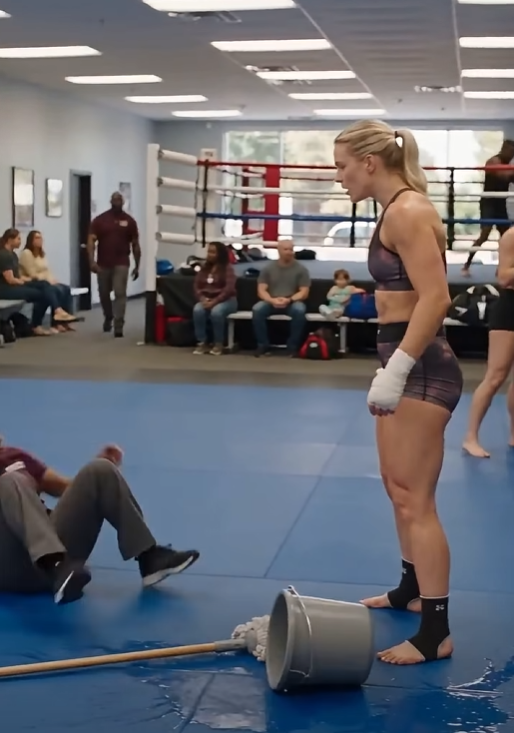
By the time the water spread across the blue training mat, almost everyone in the gym had stopped talking.
A plastic bottle rolled beneath a nearby bench, leaving a shining trail across the floor. The water gathered around the edge of the mat, soaking into the towel someone had left behind after training.
For a moment, the room fell silent.
Then Tessa Vaughn laughed.
It was a brief, sharp laugh, delivered loudly enough for everyone nearby to hear.
“Looks like you’ve got more work to do,” she said.
The woman holding the mop didn’t respond.
Her name was Naomi Reed. She was forty-two years old, stood five feet seven inches tall, and had a lean, athletic build that her loose work clothes did little to reveal.
She wore gray cleaning trousers, black work shoes, and a faded navy polo bearing the small logo of Eastgate Athletic Center. Her hair was neatly braided beneath a dark headscarf, and a pair of thin gloves covered her hands.
For seven months, Naomi had cleaned the gym every Tuesday and Thursday evening.
She arrived before the final classes ended, emptied the waste bins, wiped down the equipment, and made sure the training areas were safe for the next group of athletes.
Most members called her Ms. Naomi.
Others simply called her the cleaning lady.
Very few knew anything about her life before she started working there.
Tessa Vaughn, on the other hand, was impossible to overlook.
At twenty-eight, she was the reigning state kickboxing champion in the 132-pound division. She was tall, powerful, and quick, with sharp combinations and a devastatingly effective low kick.
She had won eight consecutive fights, five by stoppage, and was preparing for a televised regional title eliminator in six weeks.
Her photographs appeared on the gym’s social media pages. Young fighters studied her combinations, and local sponsors regularly sent her equipment.
There was no question that Tessa was talented.
The problem was that she had begun confusing talent with importance.
She expected people to make room for her, adjust their schedules for her, and laugh at her jokes even when those jokes came at someone else’s expense.
Most people tolerated her behavior because she was successful.
Naomi had never asked anyone to tolerate anything.
She simply wanted to finish her work.
Earlier that evening, the advanced kickboxing class had ended, leaving the room scattered with water bottles, hand wraps, and damp towels.
Tessa was sitting on the edge of the training ring with two teammates, Kelsey Hart and Brooke Mason. They were watching footage of Tessa’s last fight on a phone.
Naomi approached with her mop bucket.
“Ladies, could you clear this section for five minutes?” she asked. “I need to clean the floor before the children’s class begins.”
Kelsey immediately stood.
“Sure. Come on, Brooke.”
Brooke gathered her belongings and followed.
Tessa barely glanced up from the phone.
“We’re almost finished.”
Naomi waited patiently.
“I understand, but the floor needs to be dry before the next class arrives.”
Tessa sighed as though she had been asked to perform an unreasonable favor.
Naomi moved the bucket closer.
“Tessa, please. I need the mat clear.”
That finally caught the fighter’s attention.
She looked up, surprised that the quiet employee had addressed her directly.
“What?”
“I need you to step away for five minutes while I clean.”
Tessa gave a small smile.
“Are you kicking me out of the training area?”
“No,” Naomi replied calmly. “I’m doing my job.”
Kelsey shifted uncomfortably.
Brooke looked toward the doorway.
Tessa stood, picked up her bottle, and shook her head.
“Fine. Whatever.”
Naomi returned to mopping.
For a few seconds, it appeared that the matter was settled.
Then Tessa looked down at the section Naomi had just cleaned.
She glanced at the mop, then at the woman pushing it.
A careless thought crossed her mind.
She tilted her bottle and poured the remaining water across the freshly cleaned floor.
Kelsey stared at her.
“Tessa, seriously?”
Tessa laughed.
“Looks like she’s got more work to do.”
Naomi stopped moving.
Several people had witnessed what happened. A young amateur fighter stood near the mirrors, two parents were waiting beside the entrance, and Coach Malik Foster was organizing hand pads near the storage room.
Nobody could pretend the spill had been an accident.
Naomi looked at the water and then at Tessa.
Her expression remained composed.
“There’s a towel over there,” she said, pointing toward the equipment shelf. “You can use it to clean up what you spilled.”
Tessa raised her eyebrows.
“Excuse me?”
“You spilled the water. The towel is over there.”
The gym became so quiet that the faint hum of the ventilation system seemed unusually loud.
Tessa wasn’t accustomed to being challenged, especially not by someone she considered unimportant.
“Do you know who I am?” she asked.
Naomi rested both hands on the mop handle.
“Yes.”
“Then you should know I don’t have time for this.”
Naomi nodded toward the wet floor.
“Everyone has time to take responsibility for their actions.”
A few people exchanged surprised looks.
Coach Malik slowly lowered the hand pads he was holding.
Tessa’s smile disappeared.
“You’re a cleaner,” she said. “You’re supposed to clean.”
Naomi looked at her without anger.
“And you’re an athlete. You’re supposed to understand why a wet training floor is dangerous.”
That remark landed differently.
The parents near the entrance glanced toward the slippery patch. A young fighter stepped away from the mat.
Naomi continued in the same measured voice.
“Someone could slip, fall, and get hurt. I’m asking you to help keep this place safe.”
For the first time, Tessa seemed uncertain about what to say.
She had expected an argument. She had expected Naomi to lower her eyes, apologize for speaking up, or quietly clean the mess herself.
Instead, Naomi was treating the incident as a straightforward matter of responsibility.
Tessa looked toward Coach Malik.
“Are you going to let her speak to me like that?”
Malik walked over.
“Naomi is right. We need the floor safe for the next class.”
Tessa crossed her arms.
“So now everyone is taking her side?”
“No one’s taking sides,” Malik replied. “We’re asking you to clean up the water you spilled.”
Kelsey stepped forward.
“I’ll get the towel.”
“No,” Malik said gently. “Tessa can handle it.”
The champion’s face reddened.
For several seconds, she appeared ready to argue again.
Then she noticed the people watching her.
The amateur fighter by the mirrors had stopped pretending not to listen. The parents were whispering quietly. Even Brooke had moved a few steps away.
Tessa had spent years building a reputation around discipline, confidence, and determination.
Yet here she was, refusing to pick up a towel after deliberately making someone else’s work harder.
She walked toward the equipment shelf, grabbed a towel, and returned to the spill.
Her movements were stiff and irritated.
She wiped the water from the floor without looking at Naomi.
When she finished, she tossed the towel into the laundry basket.
“There. Happy now?”
Naomi examined the floor.
“Thank you. Please let me know if you need anything before the next class starts.”
Then she resumed cleaning.
She didn’t smile triumphantly. She didn’t lecture Tessa or announce that she had won an argument.
She simply returned to work.
That quiet response bothered Tessa more than an insult would have.
She gathered her belongings and left the training area with Kelsey and Brooke following behind her.
But Coach Malik remained near the ring, watching Naomi finish the floor.
After a few moments, he approached her.
“Are you all right?”
Naomi gave a small nod.
“I’m fine, Malik.”
“You shouldn’t have to deal with that.”
She wrung out the mop.
“People have bad days. Sometimes they forget that other people have them, too.”
Malik looked at her thoughtfully.
“You always say things like that.”
Naomi smiled faintly.
“Because they’re usually true.”
He hesitated before asking the question he had been wondering about for months.
“Naomi, where did you learn to move like that?”
She paused.
“Move like what?”
Malik gestured toward the way she had stepped around the equipment and adjusted the mop without losing her balance.
“Your footwork. Your balance. The way you keep your shoulders relaxed. You move like someone who’s spent years in a fight gym.”
Naomi looked down at her gloved hands.
For the first time that evening, a hint of sadness crossed her face.
“I used to compete.”
Malik stared at her.
“Compete in what?”
“Kickboxing.”
He laughed briefly, assuming she was joking.
Naomi didn’t laugh with him.
“You were a kickboxer?”
“A long time ago.”
“How long?”
“Long enough.”
Malik studied her face.
“Were you any good?”
Naomi considered the question before answering.
“I won a few important tournaments.”
That understated reply made him even more curious.
“What was your name in competition?”
She hesitated.
“Naomi Reed.”
Malik’s expression changed.
He repeated the name quietly, as if searching his memory.
Then he pulled out his phone.
“Wait here a moment.”
He walked toward the office and began searching through old tournament records. A few minutes later, he returned holding the screen toward her.
An old photograph showed a younger Naomi standing in a ring, wearing competition gloves and a championship medal.
Beneath the picture was a tournament result listing her as the winner of a major regional amateur kickboxing championship.
Malik looked from the photograph to Naomi.
“That was you?”
She nodded.
“Before life got complicated.”
The photograph had been taken nearly two decades earlier.
Back then, Naomi had trained six days a week, traveled for competitions, and dreamed of becoming a professional fighter. She had been known for her calm defense, precise counterattacks, and ability to remain composed when opponents tried to intimidate her.
But life had eventually taken her in another direction.
An injury interrupted her progress. Family responsibilities followed, and she found herself needing stable work more urgently than another competition.
She didn’t consider her years in the ring wasted.
They had taught her patience, discipline, and the importance of knowing when not to react.
Eventually, she stopped competing.
She never stopped loving the sport.
Malik lowered his phone.
“Why didn’t you tell anyone?”
Naomi returned to the mop bucket.
“Because I’m here to work, not to tell stories about who I used to be.”
The next morning, Malik arrived early and spoke with the gym’s management about what had happened.
He made it clear that all employees deserved respect, regardless of their position, and that deliberately creating a slippery training area was unacceptable.
Tessa was asked to attend a meeting before her next session.
At first, she was defensive.
She argued that the incident had been exaggerated and insisted she had cleaned up the spill.
Malik listened before explaining that the issue wasn’t simply the water.
It was the decision to humiliate someone who had asked her to follow a reasonable safety request.
“You want people to respect you as a champion,” he told her. “Then you need to show them what being a champion means when nobody is handing you a trophy.”
Tessa left the meeting in silence.
Over the following week, she found herself thinking about Naomi more often than she wanted to admit.
She remembered the older woman’s steady voice, the way she had refused to be intimidated, and the complete lack of interest she had shown in proving herself.
Tessa had spent years believing confidence meant making sure everyone knew where she stood.
Naomi seemed to understand that genuine confidence did not require an audience.
Several days later, Tessa arrived at the gym before her usual training session.
Naomi was cleaning near the heavy bags.
The champion stood a short distance away, holding a fresh bottle of water.
“Ms. Naomi?”
Naomi looked up.
“Yes?”
Tessa shifted her weight.
“I wanted to apologize for what I did last week.”
Naomi waited.
“I was disrespectful,” Tessa continued. “You asked me to move so you could clean, and I deliberately made your job harder. I thought it was funny, but it wasn’t.”
She held out the bottle.
“I brought you this. I know it’s not much, but I wanted to do something instead of just saying sorry.”
Naomi accepted the water.
“Thank you for apologizing.”
Tessa glanced at the floor.
“Coach told me about your kickboxing career.”
Naomi raised an eyebrow.
“He did?”
“He showed me the tournament photograph. You were a champion.”
“I competed a long time ago.”
“Still,” Tessa said, “you know more about this sport than I ever realized.”
Naomi considered her words.
“Being a good fighter is about more than knowing how to throw a punch. You need discipline, awareness, and respect. Without those things, talent can take you only so far.”
Tessa nodded slowly.
“I think I needed to hear that.”
Naomi returned to her work.
“And remember to watch where you leave your water bottle.”
For the first time since the incident, Tessa laughed without trying to make anyone else the target of the joke.
“I will.”
Their relationship did not transform overnight. Trust had to be earned, and one apology could not erase every careless attitude Tessa had developed over the years.
But she began treating the gym staff differently.
She moved equipment when asked, cleaned up after herself, and thanked the people who maintained the training areas.
Before her next fight, she even asked Naomi whether she would watch a few rounds of her training.
Naomi agreed.
She didn’t offer dramatic speeches or promise to turn Tessa into a better fighter in a single afternoon. Instead, she pointed out small details: the way Tessa dropped her guard after a combination, the moments when frustration made her rush, and the importance of staying balanced when an opponent refused to react as expected.
Tessa listened.
For the first time, she understood that the quiet woman she had once dismissed possessed something that could not be measured by social media followers, championship belts, or sponsorship contracts.
Experience.
Perspective.
And the confidence to remain calm when someone else tried to make her feel small.
Months later, Tessa won her regional title eliminator.
When reporters asked her what had helped her prepare, she spoke about her coaches, her teammates, and the people who worked behind the scenes to keep her gym running.
She even mentioned Naomi.
“There’s a woman at our gym who taught me an important lesson,” Tessa said. “She reminded me that the way you treat people when you have an advantage says more about your character than any victory does.”
Naomi never asked for recognition.
She continued arriving on Tuesday and Thursday evenings, pushing her mop across the same blue floor and making sure the next class could train safely.
But the people at Eastgate Athletic Center began seeing her differently.
Not because she had once been a champion.
Because she had demonstrated the kind of strength that did not need to be announced.
Tessa had entered the gym believing that respect came with a title.
Naomi showed her that it begins with the simplest choices: listening when someone speaks, taking responsibility for your actions, and remembering that every person deserves dignity.
And that lesson turned out to be more valuable than any trophy hanging on the gym wall.