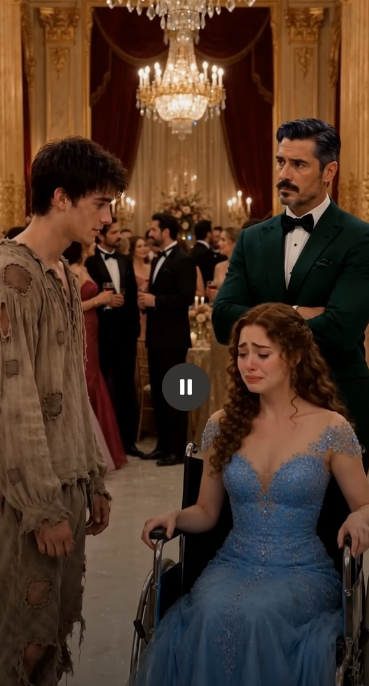
A Barefoot Boy Asked to Dance With a Girl in a Wheelchair—Then He Made an Extraordinary Promise
“Please, let me dance with her.”
The boy’s quiet request echoed through the magnificent ballroom.
Conversations stopped. Guests turned away from their tables, and the musicians gradually lowered their instruments. Beneath the sparkling chandeliers, hundreds of elegantly dressed guests watched a barefoot boy standing in the middle of a room filled with luxury and privilege.
His clothes were worn and dusty. His trousers were faded, and his shirt looked as though it had been washed countless times. He stood out among the expensive suits, glittering jewelry, and designer gowns.
Yet he didn’t seem concerned about the attention.
His eyes were fixed on a young girl sitting in a wheelchair near the center of the ballroom.
She wore a beautiful blue dress that shimmered whenever the light touched it. Her hair had been carefully arranged for the evening, and a delicate bracelet rested around her wrist. Everything about her appearance suggested that her family had spent hours preparing her for this special occasion.
But despite the elegance surrounding her, the girl looked lonely.
She had watched other children dancing throughout the evening. Each time the music began, her eyes followed the couples moving across the polished floor. Whenever someone invited her father to join a conversation, she returned to watching the dancers.
She wasn’t interested in the expensive decorations or the grand celebration.
She wanted to experience something that many people in the room took for granted.
She wanted to dance.
Her father, a wealthy businessman accustomed to controlling every detail of his life, immediately stepped between the boy and his daughter.
“Do you understand where you are?” he asked coldly.
The boy looked at him without hostility.
“Yes, sir.”
“Then you should understand that this is a private event. You cannot simply walk in here and make demands.”
The boy glanced toward the girl again.
“I’m not making a demand. I’m asking her to dance.”
The father frowned.
He had spent years protecting his daughter from disappointment. Since her mobility had become limited, he had arranged the finest care, consulted specialists, and provided every comfort his wealth could offer.
He had bought her beautiful dresses, organized memorable holidays, and filled her room with gifts. Whenever she expressed a wish, he tried to find a way to fulfill it.
Yet there were moments when even his considerable resources couldn’t give her what she wanted most.
Watching her sit alone while other children danced had become one of those moments.
Now a barefoot stranger had appeared and was asking for permission to approach her.
“Who are you?” the father demanded.
The boy didn’t immediately answer.
Instead, he looked at the girl.
She had been listening to their conversation, and for the first time that evening, her expression had changed. Curiosity had replaced some of the sadness in her eyes.
The boy noticed.
He smiled gently and extended his hand toward her.
“Would you like to dance with me?”
The girl looked at her father.
He shook his head slightly, uncertain about what to do.
“Sweetheart, we don’t know this boy,” he said.
“I know,” she answered softly.
It was the first time she had spoken during the entire exchange.
The father turned toward her.
“You want to dance with him?”
She nodded.
A few guests exchanged surprised looks. Others leaned forward, eager to see how the situation would unfold.
The father returned his attention to the boy.
“What exactly do you think you can do for my daughter?”
The question sounded more like a challenge than a request for information.
The boy lowered his hand for a moment.
Then he answered with a confidence that seemed unusual for someone so young.
“I think I can help her stand.”
The ballroom erupted in whispers.
Some guests looked astonished. Others shook their heads, assuming the boy had made a promise he couldn’t possibly keep.
The father stepped forward.
“Be careful with your words,” he said. “My daughter has been examined by experienced professionals. We’ve spent years learning what is safe for her.”
The boy listened without interrupting.
“I’m not saying I can change everything,” he replied. “I’m saying we shouldn’t decide what she can do before we ask her what she wants to try.”
The father’s expression hardened.
“You don’t know anything about her situation.”
“You’re right,” the boy admitted. “I don’t know everything.”
He paused and looked at the girl.
“But I know she wants to dance.”
The girl lowered her gaze to her hands.
For months, she had grown accustomed to adults discussing her future while she sat nearby, listening. They talked about treatments, appointments, equipment, and limitations. Most of them meant well, but she sometimes felt as though her wishes had become secondary to everyone else’s concerns.
The barefoot boy had asked her a simple question.
He hadn’t asked what the doctors had said.
He hadn’t asked how much money her father had spent.
He had asked whether she wanted to dance.
And she did.
The father noticed the expression on his daughter’s face. It was different from the hopeful smile she sometimes offered when someone promised her a new toy or an exciting trip.
This was a deeper kind of hope.
It frightened him because he knew that hope could be followed by disappointment.
“Suppose she gets hurt?” he asked.
“Then we stop,” the boy replied. “And we make sure she’s safe.”
“Suppose she can’t stand?”
“Then we can still dance while she’s sitting down.”
For a moment, the father had no answer.
The boy wasn’t insisting that the girl must stand. He wasn’t promising a miracle or claiming that her difficulties would disappear.
He was simply offering her a chance to participate.
The girl lifted her head.
“Daddy,” she whispered, “can I try?”
Her father looked at her for a long time.
He wanted to protect her. That instinct had guided nearly every decision he had made since learning how much her mobility had been affected.
But he also remembered something she had told him weeks earlier.
She had said that she didn’t want every special occasion to become another reminder of what she couldn’t do.
She wanted to make memories of her own.
The father slowly knelt beside her wheelchair.
“If we try anything, we do it carefully,” he said. “And we stop the moment you feel uncomfortable.”
The girl nodded eagerly.
The boy stepped back to give them room.
Before anyone attempted to help her stand, the father called for the medical professional who accompanied his daughter at important events. He explained what the boy had proposed and asked for guidance about what movements would be appropriate.
The professional approached, listened carefully, and assessed the situation.
Nobody would force the girl to stand, and no one would attempt a movement that might put her at risk.
The boy waited patiently.
For the first time since he had entered the ballroom, several guests stopped judging him by his appearance and began paying attention to what he was actually saying.
When everything was ready, the girl placed her hands on the wheelchair’s armrests.
Her father stood close beside her, ready to support her if needed.
The boy moved into position in front of her.
“There’s no hurry,” he told her. “We can take our time.”
The girl took a slow breath.
She shifted forward slightly, concentrating on her balance.
For a moment, nothing happened.
Then she lifted her head and looked directly at the boy.
“I’m scared,” she admitted.
He nodded.
“That’s okay. You don’t have to pretend you’re not.”
She glanced at her father, who gave her an encouraging smile.
“You can stop whenever you want,” he reminded her.
The girl took another breath.
With the guidance and support available to her, she began making a careful effort to rise.
The movement was small.
It wasn’t effortless, and it wasn’t the kind of scene that could honestly be described as an instant cure. Her body trembled as she concentrated, and the people nearby watched in complete silence.
But she was trying.
And for that moment, trying was enough.
The boy offered his hand without pulling her forward.
She reached for it.
Their fingers met.
The father held his breath as his daughter continued her careful movement, supported by the people around her.
Then she managed to lift herself a little higher.
Her eyes widened.
“Daddy,” she whispered, “I’m doing it.”
Her father felt tears gathering in his eyes.
He had witnessed countless medical appointments and difficult days. He had learned to celebrate small improvements while guarding himself against unrealistic expectations.
Yet nothing had prepared him for the emotion of seeing his daughter take an active part in something she had