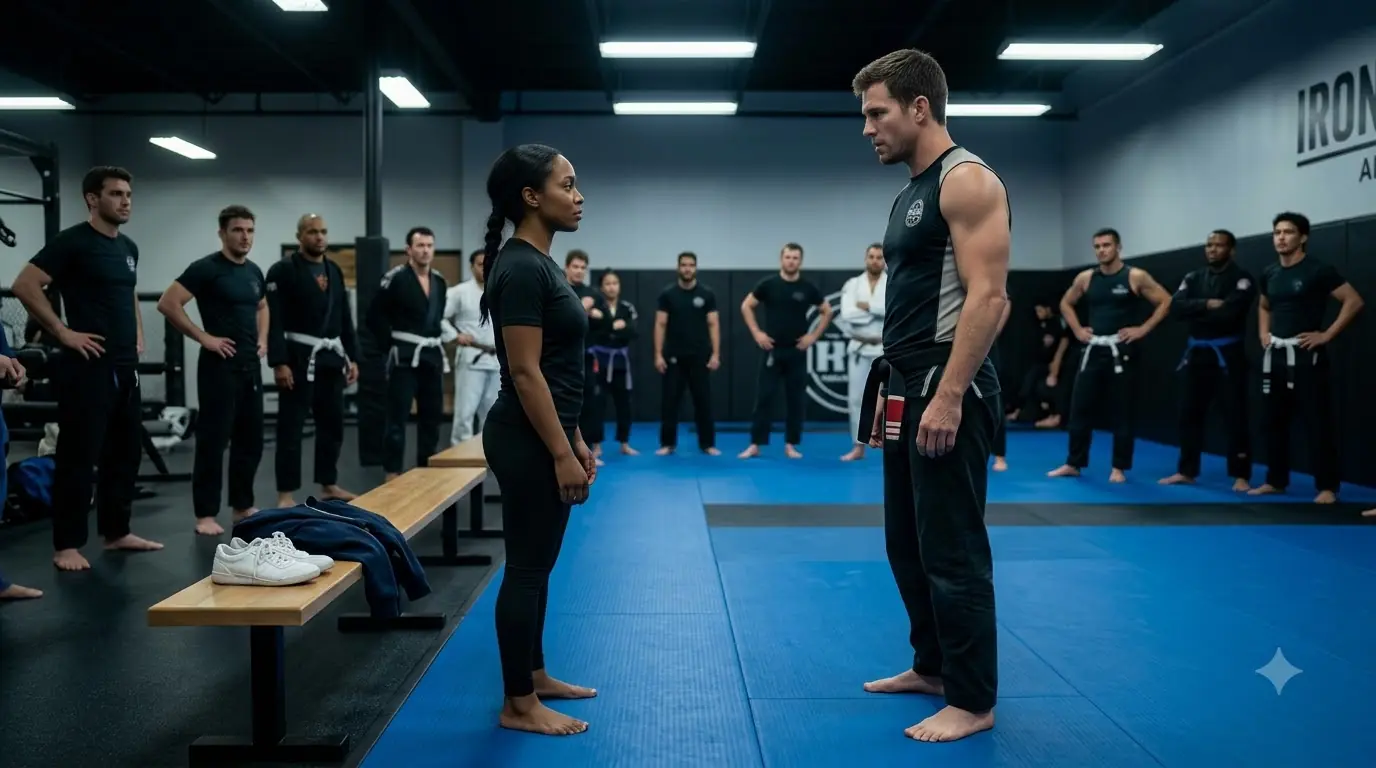
The Champion Mocked the Quiet Woman, Saying, “This Mat Isn’t for Little Girls”—Then She Removed Her Jacket
“This mat isn’t for little girls.”
Evan Mercer delivered the remark with a laugh, turning his head slightly toward the students gathered around him.
It wasn’t quite cruel enough to sound openly hostile, but it wasn’t friendly either. It was the kind of comment designed to make other people laugh while allowing the speaker to pretend it was only a joke.
Several students chuckled.
The woman standing near the edge of the mat didn’t react.
She remained still, her hands resting at her sides, her expression calm enough to make Evan wonder whether she had even understood the insult.
She was small, at least compared with the athletes surrounding her.
Barely five feet two inches tall, she appeared to weigh no more than 115 pounds. Her dark hair was gathered into a low braid, and her faded jeans, white sneakers, and navy jacket made her look more like someone who had stopped by to ask a question than a person preparing for an advanced martial arts session.
She carried no obvious gym bag.
There was no belt tied around her waist and no academy logo on her clothing.
Nothing about her appearance announced that she had experience on a competition mat.
Nothing suggested that she had earned recognition in the world of martial arts.
And because Evan didn’t know her, he decided that he already understood her.
A beginner, perhaps.
A visitor who had wandered into the wrong room.
Someone’s younger sister, girlfriend, or mother waiting for a class to finish.
Whatever her reason for being there, he was certain she didn’t belong among his advanced students.
That assumption would soon become the most important mistake he made that afternoon.
Evan Mercer was not an ordinary instructor trying to impress a room full of strangers. At thirty-four, he had built a respectable reputation in competitive grappling.
He stood six feet one inch tall, weighed approximately 188 pounds, and held a Brazilian jiu-jitsu black belt. His background included collegiate wrestling, regional no-gi competitions, and several state-level grappling medals.
He was also the head coach of the competition team at Iron Harbor Martial Arts.
His photograph hung prominently on the academy wall. In it, he wore a medal around his neck, his expression confident and satisfied after a successful tournament.
His students respected his technical ability. Younger athletes watched his demonstrations carefully, hoping to learn the small details that separated experienced competitors from beginners.
Evan had earned his achievements through years of training.
He was strong, skilled, and accustomed to being taken seriously.
That was precisely why his behavior toward the unfamiliar woman was so revealing.
He had worked hard to become one of the best athletes in his local circuit, but somewhere along the way, confidence had begun to blur into certainty about other people.
He believed he could recognize a fighter at a glance.
He believed size, clothing, posture, and reputation told him almost everything he needed to know.
And when the quiet woman failed to match his expectations, he treated her as though she had already failed a test she hadn’t agreed to