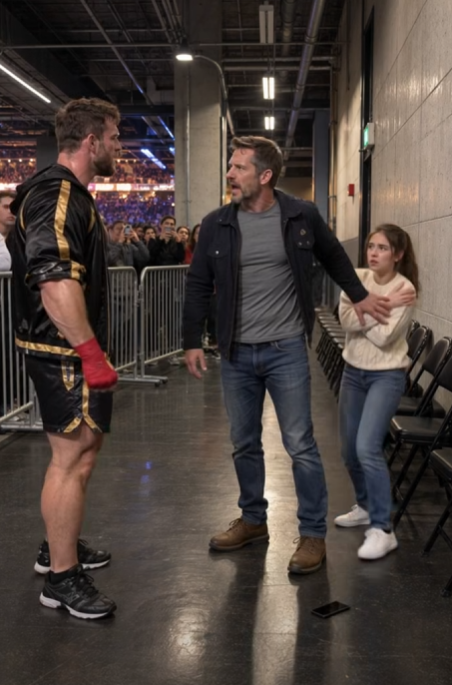
A Former Fighting Coach Tried to Protect His Daughter at an Arena—Then His Hidden Past Came to Light
I had one hand resting on my daughter’s shoulder when the enormous man standing in front of us grabbed the front of my jacket.
His face was red with frustration. His voice was loud enough to attract the attention of everyone nearby.
“What exactly do you think you’re going to do?” he demanded.
I had already asked him to stop twice.
I looked directly at him and said it one more time.
“Let go of my jacket. We don’t want any trouble.”
He had no idea who I was.
He didn’t know that I had spent fifteen years teaching professional athletes how to remain calm under pressure. He didn’t know that I had once trained some of the most determined competitors in the country.
And he certainly didn’t know that I had spent the previous nine years trying to leave that entire chapter of my life behind.
But the most important thing he didn’t understand was that I wasn’t standing there to prove anything.
I was standing between him and my daughter.
Her name was Sadi.
She was fourteen years old, curious about everything, and had a habit of noticing things that adults often overlooked.
She was also the reason I had worked so hard to become a different person.
Nine years earlier, I had promised myself that my daughter would grow up knowing a father who was patient, dependable, and present.
I had no intention of breaking that promise.
Unfortunately, that evening at Hawthorne Crown Arena was about to test everything I believed about the kind of man I had become.
The Promise I Made After Losing My Wife
I learned the importance of letting go during the year my wife died.
Her name was Leah.
She was the kind of person who could make an ordinary afternoon feel special simply by deciding to enjoy it. She laughed easily, remembered everyone’s birthdays, and believed that small acts of kindness mattered more than grand promises.
When she passed away, our daughter, Sadi, was only six.
I thought I understood grief until I watched my little girl experience it.
She would hold on to her mother’s scarf long after it had stopped carrying her familiar scent. She kept a small photograph beside her bed and sometimes spoke to it before falling asleep.
I wanted to fix everything for her.
I wanted to remove every painful memory and replace it with something happier.
But there was no way to do that.
One evening, I found her sitting on the living room floor, holding a photograph of Leah.
She looked up at me.
“Dad, if I remember everything about Mom, does that mean I won’t miss her as much?”
I sat beside her.
“I don’t know, sweetheart.”
“Then why do people say time makes things better?”
I thought carefully before answering.
“Maybe time doesn’t make us forget. Maybe it teaches us how to carry the memories without letting them hurt us every minute.”
She looked at the photograph again.
Then she placed it carefully on the table.
I watched her do that and realized something important.
Children sometimes understand difficult truths long before adults are ready to accept them.
Over the following years, Sadi slowly found her way forward.
She returned to school, made friends, developed new interests, and began laughing more often.
I never tried to replace her mother.
I simply tried to give her a home where she could speak about Leah whenever she wanted.
And whenever she needed me, I made sure I was there.
That became my most important responsibility.
Not my old career.
Not my reputation.
Not the people who remembered my name from years earlier.
My daughter came first.
The Interest I Never Expected
By the time Sadi turned nine, she had developed a particular interest in martial arts.
It started accidentally.
One evening, I fell asleep on the living room couch while watching television.
When I woke up, nearly forty-five minutes had passed.
Sadi was sitting on the floor in front of the television.
A legal pad rested on her knees, and she was watching a documentary about professional grappling competitions.
She looked so focused that she barely noticed I had moved.
“What are you watching?” I asked.
She turned around.
“Something interesting.”
I looked at the screen.
Two competitors were demonstrating their technical skills while a commentator explained the rules.
“Since when are you interested in this?”
She shrugged.
“I saw a video at school. Someone said wrestling was only about being stronger, but that doesn’t seem right.”
I smiled.
“What makes you think that?”
She pointed toward the television.
“They’re both trying to understand what the other person is going to do. It looks more complicated than people think.”
I sat down beside her.
“You’re right. There’s a lot more to it than physical strength.”
That was the beginning.
Within a few weeks, Sadi could recognize several well-known competitors and explain the difference between different competition formats.
She learned the basic terminology, followed tournament announcements, and began keeping notes about athletes she admired.
Her favorite subject was grappling.
She described it as a complicated puzzle in which two people had to think, react, and adapt at the same time.
I found her enthusiasm amusing.
What she didn’t realize was that I knew considerably more about the subject than an ordinary parent.
When she asked questions, I answered them.
I explained why certain approaches were effective, why timing mattered, and how experienced competitors learned to recognize patterns.
Eventually, she began to suspect something.
One evening, while we were eating dinner, she put down her fork.
“Dad, how do you know all this?”
I looked up.
“Know what?”
“Everything about the competitions.”
I smiled.
“I’ve spent some time around that world.”
“How much time?”
“Quite a bit.”
“Did you compete?”
I paused.
“Not exactly.”
She narrowed her eyes.
“That sounds like an answer people give when they’re hiding something.”
I laughed.
“You’ve been watching too many mystery shows.”
She wasn’t convinced.
But I changed the subject, asking whether she wanted another slice of toast.
It worked that evening.
It wouldn’t work forever.
The Invitation That Changed Our Weekend
I had been working in a small office for several years when Marcus, the man who managed the front desk, walked into my room one Tuesday morning.
He placed two tickets on my desk.
“Do you have plans for next Saturday?”
I looked at them.
They were premium seats for a major professional fighting event at Hawthorne Crown Arena.
The main attraction was Rhett Dugan, a heavyweight competitor who had become extremely popular among sports fans.
“Where did these come from?” I asked.
“Someone couldn’t use them. I thought you might enjoy going.”
I looked at the tickets for a moment.
My first instinct was to decline.
I hadn’t attended a major event in years.
The atmosphere, the crowds, the familiar announcements, and the excitement surrounding the competitors all reminded me of a life I had deliberately left behind.
But then I remembered Sadi.
That evening, I mentioned the tickets while we were eating dinner.
She was halfway through a glass of water when I told her.
For a moment, she didn’t move.
Then she slowly put the glass down.
“Are you serious?”
“About the tickets?”
She nodded.
I handed them across the table.
She read the details twice.
Her expression changed, but she didn’t immediately start celebrating.
Instead, she looked at me with a carefully controlled smile.
“Are we actually going?”
I recognized that expression.
It was the same one she had worn during the difficult months after Leah’s death whenever she wanted something but was afraid to become too excited.
I reached across the table and touched her hand.
“Yes. We’re going.”
Her smile appeared almost immediately.
She stood up, walked around the table, and hugged me.
For the next three weeks, the event became the most discussed subject in our home.
She researched the competitors, watched interviews, read about previous tournaments, and made a list of questions she wanted to ask me.
I pretended to be annoyed by the constant conversation.
In reality, I was enjoying every minute.
It felt good to share something with her.
Something that belonged to her interests rather than my responsibilities.
I didn’t realize how much that evening would change both of us.
The Night at Hawthorne Crown Arena
The arena was almost full when we arrived.
More than ten thousand people had gathered for the event.
The atmosphere was electric.
Music played through the speakers, spectators discussed their predictions, and large screens displayed interviews with the competitors.
Sadi was fascinated.
She kept looking from the competition floor to the surrounding seating areas.
She had brought a water bottle, but she was so interested in everything happening that she barely remembered to drink from it.
We found our seats approximately twenty minutes before the main event.
From our position, we had a clear view of the competition area.
Sadi leaned toward me.
“Do you think Rhett will win?”
“He’s certainly experienced.”
“That’s not an answer.”
I laughed.
“Then I’ll say it depends on how he handles the pressure.”
She nodded thoughtfully.
A few minutes later, the lights changed.
The audience began cheering.
Rhett Dugan made his entrance.
He was an imposing heavyweight athlete, standing approximately six feet two inches tall and weighing more than two hundred pounds.
He had built a reputation through years of professional competition and had become one of the most recognizable names in his division.
His confidence was obvious.
He walked toward the competition area as though he expected the entire building to be watching him.
And, of course, it was.
Sadi watched carefully.
“He’s bigger than I expected,” she whispered.
“Appearances can be misleading,” I replied.
She smiled.
“You always say that.”
“Because it’s usually true.”
The event began.
For several rounds, Rhett appeared determined to control the contest.
However, his opponent had prepared carefully.
Rather than allowing Rhett to dictate the pace, he remained patient, made intelligent decisions, and gradually changed the direction of the match.
As the rounds passed, the audience began to realize that the result might not be what they had expected.
By the fifth round, Rhett was visibly frustrated.
His opponent had maintained a disciplined approach and refused to be drawn into the kind of contest Rhett preferred.
When the final decision was announced, the result was clear.
Rhett Dugan had lost.
The crowd reacted with a mixture of surprise and disappointment.
Sadi looked toward me.
“Wow. I didn’t expect that.”
“That’s competition,” I said. “Preparation matters, but so does the ability to adapt.”
She nodded.
Then she looked toward the competition area.
Rhett was having difficulty accepting the result.
His frustration was becoming increasingly visible.
He spoke sharply with the officials, gestured toward his corner, and appeared unwilling to leave the area.
His coaching team tried to calm him.
But he continued expressing his disappointment.
I recognized the signs.
Losing an important competition can be difficult, especially when an athlete has spent months preparing for it.
But there comes a point when disappointment must give way to responsibility.
Unfortunately, Rhett was not ready to make that transition.
An Ordinary Moment Becomes Something Else
I noticed the atmosphere changing before Sadi did.
The audience was beginning to leave its seats.
People were talking about the result, checking their phones, and making their way toward the exits.
Rhett had moved away from the competition area and was walking along a corridor beside the floor seating.
I gently touched Sadi’s shoulder.
“Let’s start heading toward the exit.”
She looked up.
“Already?”
“Yes. It’ll get crowded.”
She picked up her belongings without arguing.
As we moved toward the aisle, a man standing nearby raised his phone to record Rhett.
The athlete noticed.
He turned abruptly and knocked the phone out of the man’s hand.
The device landed several feet away and slid across the floor.
It stopped near Sadi.
She looked down.
Then she looked toward the man who had dropped it.
Without thinking too much about it, she picked it up.
“Excuse me,” she said. “I think this is yours.”
That was when Rhett turned around.
He saw the phone in her hands.
He saw a young girl standing near the corridor.
And he apparently assumed she had been recording him.
I stepped between them immediately.
“The phone belongs to that gentleman,” I explained. “My daughter was simply returning it.”
Rhett looked at me.
For a moment, he said nothing.
Then he made a dismissive gesture.
“Move along.”
“We’re leaving,” I replied. “There’s no reason to make this difficult.”
He looked at Sadi.
Then he looked back at me.
“Tell your daughter to stop getting involved.”
I kept my voice calm.
“She’s done nothing wrong.”
The man whose phone had fallen was still standing nearby.
He approached cautiously.
“That’s my phone,” he said. “The girl was just helping me.”
Rhett appeared increasingly irritated.
People were beginning to notice the conversation.
Several spectators had stopped walking.
Others were watching from a distance.
I could feel Sadi standing behind me.
I turned slightly.
“Stay close, sweetheart.”
She nodded.
Rhett took another step forward.
“You should take your daughter and leave.”
“That’s exactly what we’re trying to do.”
He placed a hand against my shoulder and pushed me backward.
I took a step to maintain my balance.
Then I looked at him.
“Please don’t touch me.”
He laughed briefly.
A few people nearby turned their phones toward us.
He appeared to believe that the situation was an opportunity to demonstrate his authority.
But I wasn’t interested in arguing.
I wanted to leave.
I had spent years learning that the ability to control a situation was often more valuable than the ability to dominate it.
“Let us pass,” I said.
Instead, Rhett moved closer.
His hand reached toward the front of my jacket.
He grabbed the material near the collar and pulled me slightly forward.
“What exactly are you going to do?”
I looked past his shoulder.
Sadi was standing two steps behind me.
She was holding the stranger’s phone carefully against her chest.
She was watching my face.
And suddenly, I understood that whatever happened next would become a memory she might carry for the rest of her life.
I had spent nine years teaching her that people could resolve disagreements without losing control.
Now I had to demonstrate that those lessons were real.
I looked at Rhett.
“Let go of my jacket.”
He didn’t.
I repeated myself.
“Please let go.”
For a few seconds, the noise of the arena seemed distant.
I could hear people speaking nearby.
I could hear Sadi breathing.
And I could feel the old instincts returning.
But I also remembered the promise I had made to myself.
I would not allow my past to decide the kind of father I was going to be.
The next few seconds were confusing.
Security personnel began moving toward us.
Someone called for assistance.
The man with the phone stepped backward.
Rhett released my jacket, and the situation quickly moved beyond the control of either of us.
I did not pursue him.
I did not attempt to continue the argument.
I simply stepped away, took Sadi’s hand, and walked toward the nearest security officer.
“Are you all right?” I asked her.
She nodded.
But she wasn’t looking at me.
She was looking at the people recording us.
I knew the evening was far from over.
The Video Everyone Wanted to See
By the time we arrived home, the first recordings had already begun appearing online.
I learned about them when my phone started receiving messages from people I hadn’t spoken to in years.
Some wanted to know whether I was involved.
Others sent links to short videos.
The recordings showed different parts of the confrontation.
One began when Rhett was already standing close to me.
Another showed the moment he reached for my jacket.
A third focused on Sadi holding the phone.
The problem was that none of the early recordings showed everything.
Each clip presented a different portion of the incident.
People began drawing conclusions.
Some believed Rhett had simply been frustrated after losing an important competition.
Others criticized his behavior.
A few questioned why I had become involved at all.
I switched off my phone.
Then I prepared something for Sadi to eat.
She sat quietly at the kitchen table.
After several minutes, she finally spoke.
“Dad?”
“Yes?”
“Are you okay?”
I placed a plate in front of her.
“I’m fine.”
“That man was really angry.”
“He was having a difficult evening.”
“That doesn’t mean he should treat people like that.”
I smiled.
“You’re right.”
She looked down at her food.
Then she asked a question I hadn’t expected.
“Why didn’t you seem surprised when he grabbed you?”
I stopped moving.
“What do you mean?”
“You looked different.”
I pulled out the chair opposite her.
“Different how?”
“Like you already knew what to do.”
I didn’t answer immediately.
She continued.
“You were calm. Even when he was shouting.”
I looked at my daughter.
For nine years, I had carefully avoided certain conversations.
I had convinced myself that keeping my past private was the same as protecting her.
But perhaps I had been wrong.
Before I could answer, my phone rang.
It was an unfamiliar number.
I ignored it.
A moment later, another message appeared.
It was from Warren Pike.
I stared at the name.
I hadn’t seen Warren in nine years.
He had been my closest professional colleague during the most important period of my career.
He was also one of the few people who knew why I had left.
His message contained only a few words.
“We need to talk. I’ve seen the video.”
The Man From My Past
Warren called again the following morning.
This time, I answered.
“Hello, Warren.”
There was a short pause.
“Well, that’s a voice I haven’t heard in a long time.”
“I could say the same.”
“I assume you’ve seen what’s happening online.”
“I have.”
“Are you all right?”
“Yes.”
“And your daughter?”
“She’s fine.”
He exhaled.
“Good. Listen, there’s something you should know.”
I walked toward the window.
“What is it?”
“The arena has security recordings from the corridor. The event’s management team has reviewed the incident.”
I remained silent.
“They have a much longer recording than the clips circulating online. It shows what happened before the confrontation, including the phone incident and the fact that you were trying to leave.”
“All right.”
“Carol Finch is handling the matter.”
I recognized the name.
Carol had been a respected legal adviser who worked with several professional sports organizations.
“Why is she involved?”
“Because the event organizers want an accurate record of what happened. They also want to make sure everyone involved is treated fairly.”
I looked outside.
People were walking along the street, carrying shopping bags and speaking on their phones.
Ordinary life was continuing.
But my own life seemed to be moving toward a conversation I had avoided for almost a decade.
Warren continued.
“There’s something else.”
“What?”
“People are asking about you.”
I closed my eyes.
“Of course they are.”
“Somebody recognized your name from the early reports.”
I didn’t respond.
“There’s an old photograph circulating from one of the training camps. Someone has connected it to you.”
I knew exactly which photograph he meant.
It had been taken years earlier, when I was still actively working in professional sports.
I had been standing beside a group of athletes after a training session.
At the time, I had been proud of what we had built.
But the photograph represented a life I had worked hard to leave behind.
Warren lowered his voice.
“Listen to me. I think it’s time you told Sadi the truth.”
I looked toward the kitchen.
She was sitting at the table, reading something on her tablet.
“She’s already asking questions,” I admitted.
“Then don’t let the internet tell her your story.”
He was right.
And I knew it.
The Question I Could No Longer Avoid
That afternoon, Sadi came home from school earlier than usual.
She placed her bag near the stairs and walked directly into the kitchen.
“Dad, can we talk?”
I put down the book I was reading.
“Of course.”
She sat opposite me.
Then she turned her tablet around.
On the