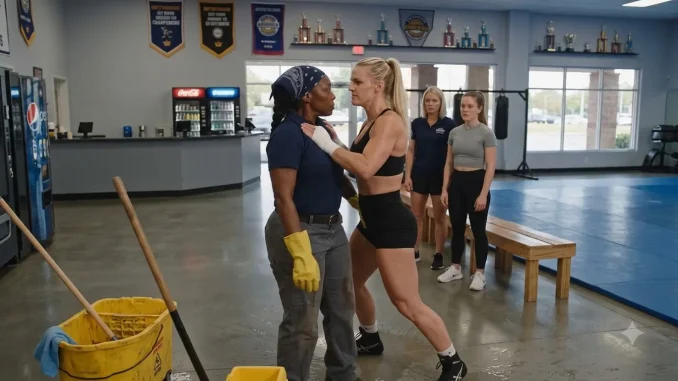
The Champion Humiliated a Janitor in Front of Everyone — He Never Imagined Who She Really Was
The first thing everyone noticed was the sound of a bucket tipping over.
The second was the elderly woman who stumbled beside it.
Water spread across the polished concrete floor near the boxing ring, carrying a thin trail of dust toward the expensive shoes of several sponsors seated along the front row. For a moment, the entire training facility seemed to fall silent.
Then someone laughed.
Another spectator reached for a phone and began recording.
At the center of the commotion stood Damon Rusk, an undefeated professional boxing champion whose name appeared on enormous promotional banners hanging from the warehouse rafters.
His slogan, printed beneath his photograph, read:
THE FUTURE DOESN’T WAIT.
Damon had one gloved hand extended. He had just pushed the woman away from his path.
He had not considered the consequences. In his mind, she was simply an employee who had failed to notice that an important person was approaching.
The woman had been cleaning the area beside the ring, wiping away a sticky patch left by a spilled sports drink. When Damon and his entourage approached, she had been too focused on her work to notice them immediately.
His hand struck her shoulder.
She lost her balance, and the mop slipped from her fingers. The bucket tipped, sending water across the floor.
The sound seemed louder than the punches exchanged during the morning’s training session.
The woman did not shout or complain.
Instead, she reached for the bucket, carefully placed it upright, and began collecting the cleaning equipment.
Her gray hair was arranged in a neat knot, although several strands had fallen beside her face. Her orange cleaning vest covered a faded navy shirt, and a small identification badge displayed the name of the cleaning company that employed her.
She was fifty-eight years old, with strong hands, a slightly stiff right hip, and a calm expression that made it difficult to understand what she was thinking.
Damon looked at her impatiently.
“Watch where you’re cleaning, sweetheart,” he said.
Several people around him laughed.
Damon was twenty-nine, undefeated in the professional cruiserweight division, and accustomed to being treated like the most important person in any room.
His shoulders filled his fitted black training shirt. His championship belt rested on a velvet-covered table behind him, surrounded by microphones, bottled water, and promotional material.
He glanced toward the spectators, apparently expecting them to appreciate his little joke.
The woman slowly stood.
She looked at the spreading water rather than at Damon.
“Someone could slip,” she said quietly. “Please step around it.”
Her voice was neither angry nor frightened.
That seemed to irritate him even more.
“Did you hear me?” Damon asked. “I told you to move.”
“I heard you,” she replied. “But the floor still needs cleaning.”
For a moment, their eyes met.
The woman then picked up her mop and continued working.
Damon shook his head and turned toward his trainer.
“Unbelievable,” he muttered.
He had no idea that the woman he had just embarrassed had once been one of the most respected figures in women’s boxing.
He also had no idea that her name had appeared on championship posters long before his own.
Her name was Eleanor Hayes.
And decades earlier, thousands of spectators had stood to applaud her.
A Woman Nobody Recognized
Eleanor had been working at the boxing facility for nearly eleven months.
Most people knew her only as the quiet cleaning lady who arrived before sunrise and left after the evening training sessions.
She rarely participated in conversations. She did not ask questions about the fighters, and she never tried to attract attention.
When the young athletes left their equipment scattered around the training area, she collected it. When visitors dropped paper cups, she picked them up. When the training staff needed the floors cleaned, she made sure the work was completed.
She performed her responsibilities with remarkable consistency.
Some employees appreciated her.
Others barely noticed she existed.
That was perfectly acceptable to Eleanor.
She had not taken the job because she needed recognition. She wanted a simple routine, a modest income, and somewhere to spend her days without being reminded constantly of a life she had once known.
Years earlier, she had been a celebrated athlete.
She had competed internationally, won major championships, and inspired young women who had never imagined themselves entering a boxing gym.
But those days were long behind her.
After retiring, Eleanor had experienced a difficult period. Her husband had passed away following a long illness, and the savings she had carefully accumulated were gradually used for family expenses and medical bills.
Her daughter lived in another country, and her grandchildren visited whenever circumstances allowed.
Eleanor could have remained at home, spending her days remembering the past.
Instead, she chose to work.
She enjoyed the simple satisfaction of completing a task properly. She liked the early morning quiet and the familiar smell of leather gloves, floor polish, and freshly washed training equipment.
Most importantly, she enjoyed being around young athletes.
Sometimes, while cleaning near the ring, she watched their footwork.
She noticed when someone leaned too far forward, when a beginner forgot