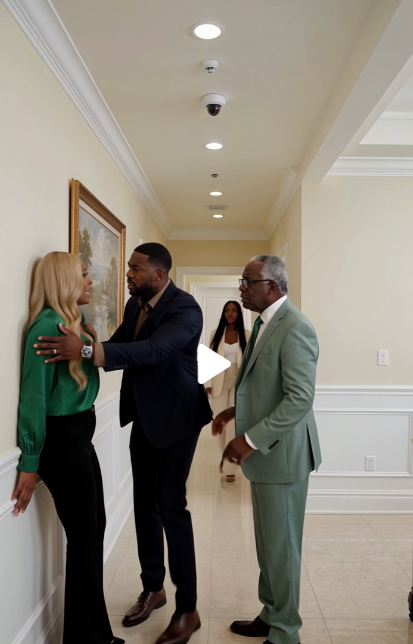
Don’t look at the camera.”
Those were the first words Mia whispered after accusing me of hurting her.
She did not ask anyone to call for help. She did not immediately explain what had happened or tell my son why she was upset. Instead, she glanced toward the corner of the living room, lowered her voice, and delivered a warning that made me pause.
My son, Daniel, stood between us with a tense expression. I could feel the soreness in my lower lip, but the discomfort barely registered compared with the confusion spreading through my mind.
It was Mia’s warning that unsettled me.
Why was she so concerned about the security camera?
And what did she believe it might reveal?
My name is Thomas Harrison. I was seventy years old that autumn, and I had been a widower for five years. Since losing my wife, Margaret, I had grown accustomed to quiet mornings, meals prepared for one, and evenings spent looking through old family photographs.
I had never imagined that a disagreement inside my own home would leave me questioning the people I loved most.
For years, I had believed that growing older meant learning to accept life’s changes with patience. I had lost my wife, retired from my job, and gradually adjusted to a world that sometimes felt much quieter than it once had.
But I had never expected to find myself at the center of a family dispute that seemed to grow more complicated with every passing minute.
Chapter 1: An Ordinary Evening Takes an Unexpected Turn
The evening had started like any other.
I had spent most of the afternoon organizing some old documents in my study. Margaret had always insisted that important papers should be kept in order, and I had continued the habit long after she was gone.
Outside, the autumn wind moved gently through the trees. The house felt peaceful, and I was looking forward to having dinner with Daniel and Mia, who had stopped by earlier that week to say they might visit.
Daniel was my only son. I had raised him with the hope that he would grow into a responsible, thoughtful man who understood the value of honesty and kindness.
When he married Mia, I welcomed her into our family. I knew that every marriage had its own routines and challenges, and I tried to give the young couple room to build a life together.
However, over the previous few months, I had noticed a change in the atmosphere whenever we were together.
Small disagreements seemed to become serious arguments. Innocent comments were sometimes interpreted as criticism, and conversations that should have ended with a simple explanation often continued long after everyone had become frustrated.
I had tried to remain patient.
At my age, I had learned that not every disagreement needed to become a battle. Sometimes, people needed time to calm down before they could understand one another.
That evening, however, patience seemed to be in short supply.
Mia was standing near the living room doorway when Daniel and I began discussing a household matter. I cannot say exactly when the conversation changed direction, but within minutes, the atmosphere became uncomfortable.
Mia raised her voice. Daniel responded sharply, and I attempted to explain what I had meant.
Then, in the confusion of the argument, Mia accused me of hurting her.
I was stunned.
I had not expected such an accusation, and I struggled to understand why the conversation had reached that point.
Daniel immediately moved between us.
“Dad, what happened here?” he demanded.
His tone carried a mixture of concern and suspicion.
I opened my mouth to answer, but Mia spoke first.
“Don’t look at the camera,” she whispered.
For a moment, I thought I had misunderstood her.
“What did you say?” I asked.
She looked toward the corner of the room again.
“Nothing,” she replied quickly.
But I had heard her clearly.
And I could not ignore the strange urgency in her voice.
Chapter 2: The Camera Nobody Wanted to Discuss
Several months earlier, I had installed a small security camera in the living room.
After Margaret passed away, I had become more conscious of keeping the house secure. The camera was intended to help me monitor the main entrance and keep a record of activity around the property when I was away.
It was a practical decision, nothing more.
I had never imagined that it would become the center of a family disagreement.
The device was positioned near a bookshelf, angled toward the main entrance and part of the living room. I had explained its purpose when it was installed, and I believed everyone who regularly visited the house understood why it was there.
Now Mia seemed unusually concerned about it.
Daniel followed my gaze toward the corner.
“What camera?” he asked.
I pointed toward the bookshelf.
“The security camera I installed earlier this year.”
His expression changed.
“Is it recording right now?”
“As far as I know, yes,” I answered. “It is designed to record activity in the room.”
Mia immediately shook her head.
“That doesn’t prove anything,” she said. “Cameras don’t always show the whole story.”
Her response surprised me.
She was right that recordings could have limitations. A camera might miss part of an interaction, and a short clip might not explain everything that happened before or after it.
But if she believed the recording was irrelevant, why had she warned me not to look at it?
I decided not to argue.
Instead, I suggested that everyone take a few minutes to calm down before discussing the situation further.
Daniel did not seem satisfied.
He wanted an explanation immediately, and I understood that he felt caught between two people he cared about. Still, I could not accept being treated as though an accusation alone established what had happened.
“I want us to understand the facts before anyone makes assumptions,” I told him.
Mia folded her arms.
“You always think you are right,” she replied.
“That isn’t what I said,” I answered. “I said we should establish what happened.”
The room fell silent.
For the first time that evening, I realized that the camera might be more than a security device. Whatever it contained could help clarify the disagreement, provided the recording was available, authentic, and viewed in its proper context.
I did not know what it would show.
But I knew that guessing would not help anyone.
Chapter 3: My Son Begins Asking Questions
Daniel sat down on the edge of the sofa and rubbed his forehead.
“Can we please stop arguing for a moment?” he asked.
I was grateful that his voice had become calmer.
Mia sat across from him, looking increasingly uncomfortable. She kept glancing toward the bookshelf, then away from it whenever she noticed me watching.
I wondered whether she was frightened that the recording might be misunderstood, or whether there was another reason for her concern.
I did not want to invent an explanation without evidence.
“Daniel,” I said, “I understand that you want to protect your wife. That is natural. But I also need you to hear what I have to say before deciding what happened.”
He looked at me.
“I am listening, Dad.”
I explained the sequence of events as I remembered them. I described the conversation, the disagreement, and the moment Mia accused me of hurting her.
I kept my account as clear as possible and avoided adding assumptions about her intentions.
When I finished, Daniel remained quiet.
Then he turned toward Mia.
“Can you explain your side of the story?”
She hesitated.
“I don’t want to discuss this while everyone is upset,” she said.
“That is reasonable,” I replied. “We can wait until everyone is calm. But we should not turn an unresolved disagreement into a conclusion about someone’s behavior.”
Mia looked down at her hands.
For a few seconds, the only sound in the room was the quiet hum of the refrigerator in the adjoining kitchen.
Then she said something I had not expected.
“You don’t understand what that camera could do.”
Daniel looked at her sharply.
“What does that mean?”
She did not answer.
I felt a chill of uncertainty, not because I had discovered anything conclusive, but because her words suggested that the camera represented something more complicated than ordinary household security.
I decided that the best course was to avoid further confrontation and preserve any relevant information until we could determine what had actually occurred.
If the recording existed, it should be handled carefully rather than used to embarrass anyone or settle the matter through accusations.
Chapter 4: The Questions I Could No Longer Ignore
Later that evening, after Daniel and Mia had left the room to speak privately, I remained seated beside the bookshelf.
I looked at the small camera mounted near the wall.
For months, it had been an ordinary part of my home. I rarely thought about it unless I checked that the device was working properly.
Now, I found myself asking questions I had never considered before.
Was the camera functioning as intended?
Had the recording been saved?
Was its time setting correct?
Would the available footage cover the relevant period, or would it show only part of the interaction?
I understood that a recording was not automatically a complete explanation. Even clear footage could require context, and I did not want to draw conclusions before examining the available information.
Still, I believed it was important to preserve any relevant recording rather than allow it to disappear through routine deletion or accidental changes.
I checked the device’s ordinary status indicators without altering its settings. I also made a note of the approximate time of the disagreement.
My intention was not to spy on my family or use private information against them. I wanted an accurate account of an event that had left everyone upset and uncertain.
I had spent most of my adult life believing that honesty was the foundation of a stable family.
If that belief meant anything, it had to apply when the truth was uncomfortable.
I also began to think about Margaret.
She had always encouraged us to speak carefully when emotions ran high. She used to say that people could recover from disagreements more easily than they could recover from words spoken in anger.
I wished she had been there to help us find our way through the confusion.
But I was alone in the living room, and the next decision was mine to make.
Chapter 5: A Family Relationship at a Crossroads
When Daniel returned, he seemed less angry than before.
“Dad, Mia and I need some time to talk,” he said. “We don’t want this to become a bigger problem.”
“I agree,” I replied.
He looked toward the camera.
“Are you going to review the recording?”
“I may need to, if it is available and relevant,” I said. “But I am not going to use it to humiliate anyone. I want to understand what happened.”
Daniel nodded slowly.
“I don’t know what to believe right now.”
“That is why we should avoid making a final judgment before we have the facts.”
He sat beside me.
For a brief moment, I saw the little boy he had once been, the child who used to come to me with questions whenever something confused him. I remembered teaching him how to ride a bicycle, helping him with school projects, and reassuring him when he faced his first major disappointment.
I had always wanted him to become someone who could think independently and treat others fairly.
Now he was an adult facing a difficult situation of his own.
I could not make the decision for him, and I did not expect him to choose sides simply because I was his father.
What I wanted was a fair conversation in which each person could explain their perspective without intimidation or pressure.
“I love you, Daniel,” I told him. “And I care about Mia, too. But caring about people does not mean we should ignore serious questions. We need to handle this honestly.”
He looked down at the floor.
“I understand.”
I hoped he meant it.
Chapter 6: The Recording Could Change Everything
That night, I did not rush to announce that the camera would prove me right or that it would expose Mia.
I had no basis for making either claim.
Instead, I focused on what I could establish: what I remembered, what had been said, and what information might be available to clarify the incident.
If the recording existed, I would review it responsibly and preserve the original file. If it did not exist, I would not pretend otherwise.
I also decided that any further discussion should take place when everyone was calm. If the accusation became a serious legal matter, I would seek appropriate professional advice rather than rely on my own interpretation of a short recording.
I was seventy years old. I had lived long enough to know that family disagreements rarely become easier when people rush to judgment.
But I had also learned that silence could allow misunderstandings to grow.
The following morning, I planned to speak with Daniel again. I wanted to know whether Mia was willing to explain why she had warned me about the camera and whether we could agree on a fair way to resolve the dispute.
For now, I had more questions than answers.
Why had Mia been so concerned about the recording?
Was she worried that the footage might be misunderstood, or was there something else she had not yet explained?
And would Daniel be willing to consider the available evidence before reaching a conclusion about his own father?
I looked once more at the camera near the bookshelf.
It had been installed to help me feel secure in my home.
I had never imagined that it would become part of a conflict involving the people closest to me.
Yet the real issue was no longer the device itself. It was whether my family could face a difficult situation with honesty, patience, and fairness.
I had no desire to destroy my relationship with my son or turn a private disagreement into a public spectacle.
I wanted the truth, and I wanted a way forward that did not require anyone to be treated unfairly.
As I turned off the living room lights, I realized that the hardest part of the story might not be discovering what the camera had recorded.
It might be discovering whether the people I loved were prepared to listen to one another when the truth became uncomfortable.
And as I waited for the next conversation with my son, one question remained in my mind: What had Mia been so afraid the security camera might reveal?