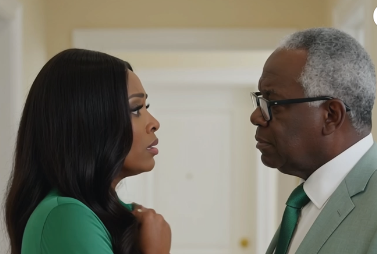
Don’t look at the camera.”
Those were the first words Mia whispered after accusing me of hurting her.
She didn’t ask anyone to call for help. She didn’t explain what had happened. Instead, she glanced toward the corner of the room, lowered her voice, and delivered a warning that made my stomach tighten.
My son, Daniel, stood between us, his face tense with anger. I could taste the metallic sharpness of blood where my lip had been split, but the physical pain barely registered.
It was Mia’s warning that unsettled me.
Why was she so concerned about the camera?
And what did she believe it might reveal?
My name is Thomas Harrison. I was seventy years old that autumn, and I had been a widower for five years. Until that evening, I believed that growing old meant learning to live with an empty house, quiet mornings, and the absence of the person who had shared nearly every important moment of your life.
I had accepted loneliness as part of the bargain.
What I had not anticipated was discovering that the people closest to me might know exactly how to use that loneliness against me.
Families are supposed to be places where people feel safe. They are where children learn to trust, where parents offer guidance, and where ordinary moments become treasured memories.
But familiarity can reveal weaknesses, too.
The people who know you best understand what makes you anxious, which memories soften your judgment, and how easily guilt can persuade you to ignore something that feels wrong.
I had spent most of my life believing that love meant giving people the benefit of the doubt.
That autumn evening would force me to question everything I thought I knew about that belief.
Yet the trouble did not begin with an argument.
It began with a bouquet of white roses.
They had been Margaret’s favorite flowers, and I had arranged them in a glass vase at the center of the dining table. I moved each stem carefully, turning the blossoms until they formed the balanced arrangement she would have approved of.
Five years had passed since cancer took my wife, but I still caught myself preparing the house as though she might walk through the kitchen door at any moment.
I could almost hear her gentle criticism.
“Thomas, those roses are crooked.”
I smiled at the memory and adjusted the vase.
“There,” I whispered. “Any better?”
The dining room remained silent.
Margaret and I had shared that house for thirty years. Every room held a piece of our history. The staircase still bore scratches from Daniel’s toy cars, and a small dent beside the kitchen doorway reminded me of the afternoon Claire had collided with the wall while learning to ride her bicycle indoors.
The pantry door carried pencil marks recording our children’s heights. Each summer, Margaret had insisted on measuring them again, even when the difference amounted to little more than a fraction of an inch.
I had once offered to repaint the door and repair the scratches.
She had refused.
“Those aren’t imperfections,” she told me. “They’re proof that we lived here.”
After she died, I understood what she meant.
The house was no longer simply a building. It had become a collection of moments I could revisit whenever I missed her.
Unfortunately, memories could not answer questions, share a cup of coffee, or tell me how the day had gone.
The silence followed me everywhere.
It waited in the kitchen each morning, settled beside me in the garden, and occupied the empty space in our bedroom. For years, I slept on my side of the mattress, unable to convince myself that moving toward the middle would make any difference.
Eventually, I developed a routine that gave the passing seasons some meaning.
Every autumn, I invited my family over for dinner.
It was a tradition Margaret had loved, and maintaining it made me feel that some part of our life together had survived.
That year, I began preparing three days in advance.
I bought fresh vegetables, polished the silverware, and prepared the roast beef Margaret had always served when the leaves turned golden. I even brought out the ceramic serving dish her mother had given us on our first wedding anniversary.
By late afternoon, the house smelled of rosemary, warm bread, and the familiar comfort of a meal prepared with care.
For the first time in weeks, I felt genuinely excited.
When Daniel arrived with his wife, Mia, followed by my daughter, Claire, and the grandchildren, the house seemed to wake up.
“Grandpa!”
Eight-year-old Ethan came charging through the front door, his excitement carrying him straight toward my knees.
“Look what I made!”
He held up a paper airplane. One wing was bent, the nose was covered in blue tape, and a series of pencil marks decorated its sides.
I examined it with exaggerated seriousness.
“Remarkable engineering,” I said. “What kind of speed are we expecting?”
Ethan considered the question.
“One hundred miles an hour!”
His older sister, Lily, appeared behind him and shook her head.
“It crashes into the couch every single time.”
“That is because the couch cheats,” Ethan replied.
I laughed so hard that my eyes began to water.
For a few wonderful minutes, I forgot how old I was. I forgot the quiet evenings and the long mornings when there was no one to talk to. I even forgot the uneasy feeling that my children had begun treating visits to my house like obligations they needed to complete.
Watching the grandchildren argue over an imaginary aircraft reminded me of the years when Daniel and Claire were young.
Back then, the house had rarely been quiet.
There had been birthday parties, school projects, muddy shoes, forgotten lunches, and endless questions about the world. Margaret and I had sometimes dreamed of a peaceful evening, never realizing how much we would eventually miss the noise.
Now I would have welcomed every interruption.
Dinner began pleasantly enough.
Daniel talked about difficulties at work, while Claire described a customer who had mistaken her for a teenager. Lily announced that broccoli violated the rights of children everywhere, and Ethan attempted to launch his airplane from the dining table.
I confiscated it before it could land in the gravy.
“An aircraft of that quality needs a proper flight plan,” I told him.
He grinned and promised to behave, although his expression suggested that the promise had a very short life expectancy.
Mia sat beside Daniel, wearing a cream blouse and small gold earrings. She looked perfectly composed, as she usually did. She had a talent for making every gesture appear thoughtful and every remark sound polite, even when the meaning underneath was less pleasant.
She was thirty-eight, confident, and accustomed to getting her way.
Eight years earlier, I had welcomed her into the family without hesitation.
When Daniel told me that he and Mia could not afford the wedding reception they wanted, I offered to help. When they began searching for their first home, I contributed money toward the purchase. Later, when Mia’s father needed surgery and their insurance left a substantial bill unpaid, I covered the difference.
I never asked them to repay me.
At the time, the decision seemed natural. I had spent my life working hard so that my children might have opportunities I never enjoyed. If I could make their lives a little easier, why wouldn’t I?
I believed generosity was one of the simplest ways to show love.
It never occurred to me that someone might interpret it differently.
“Thomas, would you pass the potatoes?” Mia asked.
I handed her the serving bowl.
“Of course.”
“Thank you, Mr. Harrison.”
I smiled.
“You know, Mia, after eight years, you can call me Dad. You don’t have to be so formal.”
Her fork paused above her plate.
Daniel glanced at his wife, then turned toward me.
“She knows that, Dad.”
“I didn’t mean anything by it,” I explained. “I just want her to feel comfortable.”
Mia placed a potato beside the roast beef.
“Some habits are difficult to change.”
She delivered the remark with a pleasant smile.
I returned the smile, although something about her answer stayed with me.
Perhaps I was being overly sensitive. Losing Margaret had made me more aware of small changes in people’s voices and expressions. Sometimes I caught myself searching for meaning where none existed.
Still, I had learned over seventy years that an uncomfortable feeling did not always disappear simply because you ignored it.
Claire seemed to sense the awkwardness and quickly changed the subject.
“Dad, did you ever find Mom’s old photo album? The one from Maine?”
“I believe it’s upstairs.”
“You should bring it down. Lily has never seen the photographs of Mom wearing that enormous sunhat.”
“I heard that!” Lily protested.
“Mom says I inherited my fashion sense from Grandma.”
“You certainly did,” Claire replied. “Unfortunately, you also inherited her inability to recognize a terrible hat.”
Everyone laughed.
Even Mia joined in, and for a moment the earlier tension faded.
I looked around the table at the people I loved most in the world. Daniel was studying his plate, Claire was helping Lily cut her food, and Ethan was secretly trying to straighten the bent wing of his airplane beneath the table.
Their lives had become complicated in ways I did not always understand. They had responsibilities, ambitions, and worries of their own. I knew that being a parent did not mean remaining the center of your children’s world forever.
Nevertheless, I sometimes wished they would ask me questions that had nothing to do with practical matters.
How had I been sleeping?
Was I lonely?
Did I need anything?
Instead, our conversations increasingly revolved around schedules, household expenses, repairs, and the occasional request for assistance.
I told myself that this was simply what happened when children grew up.
Then my gaze settled on Margaret’s empty chair.
For a moment, I imagined her sitting at the head of the table, watching the family with that familiar expression of amusement and gentle disapproval. She would probably have noticed the tension between Mia and me before either of us admitted it existed.
She had always been better at understanding people than I was.
I missed that about her more than I could explain.
“Back in a minute,” I announced, pushing my chair away from the table. “I’m going to look for the album.”
Daniel reached toward the remaining roast beef.
“Don’t eat the last piece while I’m gone.”
He grinned.
“No promises.”
The familiar exchange brought another smile to my face as I left the dining room.
I climbed the staircase slowly, one hand resting on the polished wooden railing. Behind me, the sound of conversation rose and fell. Ethan was telling a story, Claire was laughing, and Daniel had begun explaining something about work.
For a few seconds, everything sounded exactly as it should.
Then I reached the landing and noticed a thin strip of light beneath the door to my study.
I was certain I had switched off the lamp before dinner.
I stopped.
The room contained old photographs, financial documents, family records, and several boxes of belongings Margaret and I had collected over the years. It was not a secret room, but I rarely allowed anyone to enter without asking.
I pushed the door open.
The lamp beside my desk was on.
Nothing appeared obviously disturbed. My books remained on their shelves, and the drawers were closed. Yet the small black security camera mounted near the ceiling had been turned toward the wall.
I stared at it for several seconds.
I had installed the camera months earlier after discovering that some important papers had been moved from their usual place. At the time, I suspected I had simply misplaced them. Age had made me more forgetful, and I was willing to admit that.
Still, I had decided that a camera would help me keep track of the room.
I had told Daniel about it.
I had not told Mia.
I crossed the room and carefully turned the camera back toward the desk. A tiny indicator light glowed, but I could not tell whether the device had recorded anything while facing the wall.
Then I noticed something else.
The top drawer of my desk was not completely closed.
Inside it, beneath a stack of old envelopes, I kept a folder containing documents related to the house and my savings.
I opened the drawer.
The folder was still there, but it had been placed upside down.
A cold uneasiness settled over me.
Perhaps Daniel had needed something. Perhaps I had moved the folder myself and forgotten. There were ordinary explanations for almost everything, and I had spent enough of my life worrying about things that never happened.
I returned the folder to its place and picked up the photo album.
Before leaving, I glanced once more at the camera.
For reasons I could not explain, I had the distinct impression that someone had wanted me to believe the room was untouched.
I carried the album downstairs.
When I returned to the dining room, the conversation stopped almost immediately.
It was such a small change that I might not have noticed it on another evening. Daniel lowered his glass. Claire looked toward Mia, and Mia turned to me with an expression of surprise that seemed a little too carefully arranged.
“Everything all right?” Daniel asked.
“Of course,” I replied, taking my seat. “Why wouldn’t it be?”
“No reason.”
He looked down at his plate.
I placed the album beside me and opened it to a photograph of Margaret standing on a rocky beach in Maine. Her hair was blowing across her face, and she was laughing at something beyond the edge of the picture.
For a moment, I felt better.
Then Mia leaned toward me.
“Thomas,” she said quietly, “did you go into your study?”
I turned to face her.
“Yes. I went to get the album.”
She exchanged a quick glance with Daniel.
“What is it?” I asked.
“Nothing,” she replied. “I was just wondering.”
Her voice was calm, but her fingers had tightened around her glass.
I looked from her to my son.
Neither said another word.
And for the first time that evening, I wondered whether the dinner I had spent three days preparing had brought my family together for a reason I did not understand.
I closed the photo album.
Outside, the autumn wind moved through the trees, scattering dry leaves across the lawn. Inside, the room was warm, the food was plentiful, and the people around my table were the same people I had loved for decades.
Yet something had changed.
I could feel it in the pauses between their sentences, in the way Daniel avoided my eyes, and in Mia’s repeated glances toward the hallway.
I had invited them to share a meal and remember the woman who had held our family together.
Instead, I had stumbled upon a question that none of them seemed willing to answer.
What had happened in my study?
And why did Mia seem so frightened of a camera?
I did not ask again that night.
I wish I had.
Because before the evening was over, a quiet family dinner would become the beginning of a confrontation that changed the way I saw my son, his wife, and even the home where I had spent most of my adult life.
I had always believed that the truth would be easy to recognize once it appeared.
I was about to learn that the truth could be hidden behind a smile, disguised as concern, and protected by the very people you trusted to tell it.
And sometimes, the first warning came from the person who had the most to lose if you looked too closely.