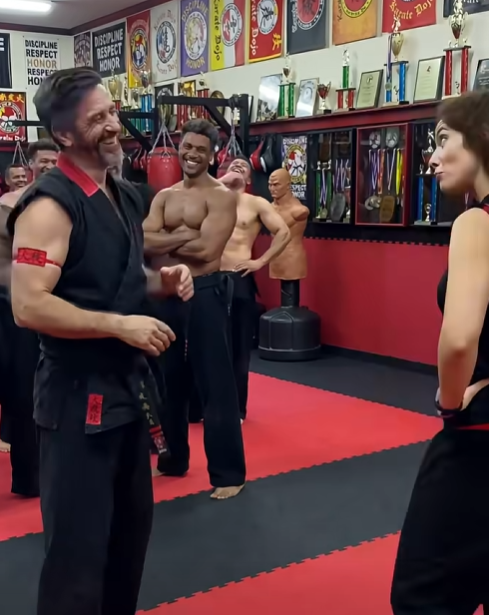
Martial arts training is about much more than physical strength, speed, or the ability to perform impressive techniques. It also teaches patience, discipline, respect, and the importance of remaining calm under pressure. Sometimes, the most memorable lessons come from unexpected situations, especially when experienced practitioners meet someone whose abilities they have not yet had the opportunity to understand.
One afternoon at a traditional martial arts dojo, a routine training session became an unforgettable learning experience for everyone present. What began as a friendly practice match between two students developed into a demonstration of balance, timing, and the importance of never judging another person’s abilities too quickly.
The story highlights a simple but meaningful principle: true skill does not always announce itself, and confidence is most valuable when it is accompanied by humility.
A Confident Fighter at the Center of Attention
The dojo was known for its disciplined training environment and welcoming atmosphere. Students arrived regularly to improve their techniques, strengthen their bodies, and develop the mental focus required for martial arts.
Among the most experienced members was a fighter who had spent years refining his movements. He was respected for his speed, technical knowledge, and consistent performance during practice sessions. His dedication had earned him a reputation as one of the strongest practitioners in the room.
Whenever the instructor organized friendly sparring exercises, other students often watched his matches closely. His movements were usually controlled and precise, and he seemed comfortable facing opponents with different levels of experience.
However, confidence can sometimes influence the way people evaluate unfamiliar situations. Even a highly trained athlete may form an opinion about another person before understanding that person’s background, preparation, or approach.
During this particular session, the experienced fighter was preparing for another lighthearted practice match when he noticed a woman standing near the training area.
She appeared calm and focused, listening carefully to the instructor’s explanations. She did not draw attention to herself or make any claims about her abilities. Instead, she watched the other students and quietly prepared for the exercises ahead.
When the possibility of a friendly match came up, the experienced fighter agreed to participate. He expected the session to be a straightforward opportunity to practice his techniques and demonstrate his experience.
What he did not realize was that the upcoming exercise would challenge his assumptions in a way he had not anticipated.
A New Opponent Enters the Training Area
The woman stepped onto the mat after the instructor explained the purpose of the exercise. The rules were simple: both participants were expected to remain respectful, maintain control of their movements, and focus on technique rather than competition.
There was no prize to win and no reason for either participant to prove anything to the audience. The goal was to practice, learn, and improve.
Although the woman appeared relaxed, she paid close attention to the distance between herself and her opponent. Her posture was balanced, her movements were economical, and she seemed more interested in observing than reacting immediately.
The experienced fighter greeted her politely before taking his position.
Around them, several students gathered to watch. Some were curious about how the match would develop, while others assumed that the more experienced practitioner would have little difficulty controlling the pace.
The instructor reminded both participants to keep the exchange light and stop whenever necessary. Once they acknowledged the instructions, the practice began.
At first, the fighter relied on familiar movements. He adjusted his stance, tested the distance, and attempted to encourage his opponent to respond. His approach reflected the habits he had developed through years of training.
The woman, however, did not rush forward or react to every movement. She remained composed and watched his positioning carefully.
Her patience changed the rhythm of the exercise.
The Importance of Patience and Observation
In martial arts, a successful response often begins before any physical technique is performed. Practitioners learn to observe body positioning, recognize patterns, maintain balance, and avoid unnecessary movements.
These principles can be difficult to appreciate when someone focuses exclusively on speed or strength.
As the friendly match continued, the experienced fighter attempted to increase the pace slightly. The woman maintained her composure, making small adjustments to her stance while keeping a comfortable distance.
She did not appear interested in impressing the spectators. Instead, she concentrated on the exercise itself.
Several students began noticing the difference between the two approaches. One participant was trying to establish control through familiar patterns, while the other was carefully evaluating the situation before deciding how to respond.
Neither approach automatically guaranteed success. However, the contrast demonstrated why martial arts requires more than repeating techniques learned during training.
A practitioner must also recognize when to wait, when to move, and when a different approach may be more appropriate.
The woman appeared to understand this principle well.
Her opponent, meanwhile, was beginning to realize that the match might require more attention than he had initially expected.
One Controlled Movement Changes the Atmosphere
As the exercise reached its most interesting moment, the experienced fighter moved forward to test the woman’s balance and positioning.
She responded with a small, controlled adjustment. Rather than meeting his movement with unnecessary force, she shifted her position, maintained her balance, and used the opening created by the exchange to demonstrate a simple technical principle.
The movement was brief and precise.
There was no dramatic collision, aggressive display, or dangerous maneuver. Instead, the exchange ended with a clear demonstration of timing and positioning that allowed the woman to establish a temporary advantage within the practice exercise.
The experienced fighter paused.
For a moment, the students watching from the edge of the mat became noticeably quieter. They had expected an ordinary training match, but they had just witnessed a reminder that experience does not eliminate the need for careful observation.
The instructor acknowledged the movement and encouraged both participants to reset.
What made the moment memorable was not that one person had defeated another. It was the simplicity of the demonstration. The woman had remained patient, recognized an opportunity, and responded with control.
Her actions illustrated a principle that experienced martial artists understand well: the effectiveness of a technique often depends on timing, balance, and decision-making rather than physical power alone.
The room’s attention shifted from assumptions about the participants to the technical lesson unfolding in front of them.
Respect Becomes the Most Important Lesson
After the exchange, the two practitioners returned to their starting positions.
The experienced fighter appeared more attentive than before. Rather than continuing with his original approach, he began paying closer attention to the woman’s movements and adjusting his own technique accordingly.
The instructor used the opportunity to explain how small differences in posture, distance, and timing can influence a training exercise.
Students were reminded that martial arts is not simply a contest between stronger and weaker individuals. It is a continuous process of learning, testing ideas safely, and recognizing areas where improvement is possible.
A person who has trained for many years may possess excellent technical knowledge, but every new partner presents different challenges. Even familiar exercises can reveal weaknesses or encourage practitioners to reconsider habits they have developed over time.
The woman did not celebrate her advantage or attempt to embarrass her opponent. She remained respectful throughout the session.
That response was just as important as the movement itself.
In a training environment, the purpose of demonstrating a technique is not to make another person feel inadequate. It is to create an opportunity for both participants to understand something more clearly.
The experienced fighter had entered the match expecting a familiar exercise. He left with a useful reminder about the value of remaining open to learning.
For the other students, the exchange demonstrated that humility is not a sign of weakness. It is an essential part of long-term development.
Why Technical Skill Matters More Than Appearances
People often form quick impressions based on confidence, physical appearance, reputation, or previous achievements. Although these impressions can sometimes provide useful information, they do not tell the whole story.
Martial arts offers a practical example of why appearances can be misleading.
A quiet student may have years of experience that others know nothing about. Someone who moves slowly may be concentrating on precision rather than speed. A practitioner who avoids unnecessary demonstrations may still possess a deep understanding of technique.
These possibilities are why responsible instructors encourage students to approach every training partner with respect.
Technical ability also depends on the situation. A technique that works well during one exercise may be less effective under different conditions. Distance, fatigue, balance, timing, and the rules of the practice all influence the outcome.
No single movement guarantees success in every encounter.
For this reason, martial artists benefit from developing several qualities together: physical conditioning, technical knowledge, awareness, adaptability, and emotional control.
The friendly match illustrated these qualities without requiring either participant to engage in an aggressive confrontation.
It also showed why experienced athletes continue training even after achieving a high level of proficiency. Progress depends on a willingness to examine familiar habits and learn from unexpected situations.
Lessons That Extend Beyond the Dojo
The meaning of the training session was not limited to martial arts.
In everyday life, people sometimes underestimate colleagues, classmates, competitors, or strangers because they lack information about their experiences and abilities.
A new employee may have valuable knowledge that is not immediately visible. A quiet student may understand a subject more deeply than expected. A person who does not seek attention may still contribute an important idea when the right opportunity arises.
The same principles that make a martial artist effective can also support better decisions outside the training environment.
Patience helps people avoid rushing to conclusions.
Observation encourages them to gather information before responding.
Adaptability allows them to change their approach when circumstances require it.
Humility makes it easier to recognize mistakes and learn from others.
Respect creates an environment where people can improve without unnecessary embarrassment or hostility.
These qualities are valuable because they encourage thoughtful responses instead of impulsive reactions.
The woman in the dojo did not need to make a speech or challenge anyone’s reputation. Her calm participation was enough to demonstrate the importance of preparation and composure.
Likewise, the experienced fighter’s willingness to continue learning showed that a single unexpected moment does not diminish years of dedication. On the contrary, the ability to learn from such moments is part of what makes experience meaningful.
A Reminder About the True Purpose of Martial Arts
By the end of the session, the attention of the students had moved away from the question of who was the strongest person in the room.
They had witnessed something more useful than a simple victory. They had seen how a controlled movement could illustrate the relationship between timing, balance, and awareness.
They had also seen how easily assumptions can influence expectations, and how quickly those expectations can change when people pay closer attention.
Martial arts training is most productive when participants understand that each practice session offers an opportunity to improve. Some days, progress comes from mastering a difficult technique. On other days, it comes from recognizing a mistake, listening to an instructor, or learning something from a partner with a different approach.
The most experienced practitioner is not necessarily the person who always wins every exercise. It is often the person who remains willing to learn, treats others respectfully, and understands that improvement is a continuous process.
The woman’s brief demonstration provided a memorable example of that philosophy. Her actions were controlled, her attitude was respectful, and her approach emphasized skill rather than confrontation.
For everyone who watched, the session offered a straightforward but lasting lesson: never assume that confidence tells the whole story, and never underestimate the value of patience.
Sometimes, the most important moment in a dojo is not the one that produces the loudest reaction. It is the moment that encourages everyone present to think differently about what real skill, discipline, and respect look like.
Final Thoughts
The friendly match served as a reminder that martial arts is built on more than physical ability. Preparation, awareness, self-control, and respect are equally important parts of the learning process.
The experienced fighter brought years of practice to the mat, while the woman demonstrated the value of patience and precise movement. Their exchange showed how two practitioners can learn from one another, even when a training exercise does not unfold as expected.
Rather than focusing on embarrassment or rivalry, the more meaningful lesson was about personal growth.
In the dojo, as in life, people benefit when they remain curious, avoid making assumptions, and recognize that everyone has something to teach. True confidence does not require dismissing others. It grows through preparation, honest self-assessment, and the willingness to keep learning.
That is what made this ordinary training session worth remembering: one carefully executed movement became an opportunity for an entire room to appreciate the lasting value of humility, discipline, and respect.